


Page 318 - (DK) Smithsinian - Military History: The Definitive Visual Guide to the Objects of Warfare
P. 318
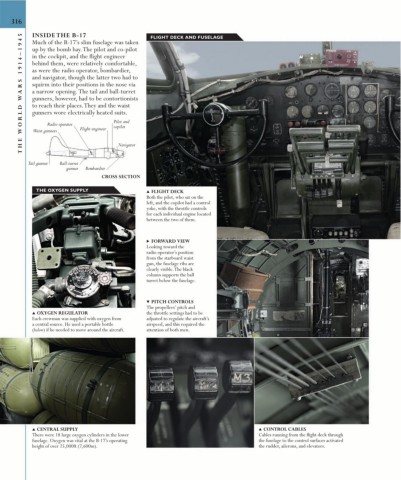
316    INSIDE THE B-17

         1914–1945  Much of the B-17’s slim fuselage was taken   FLIGHT DECK AND FUSELAGE

            up by the bomb bay. The pilot and co-pilot
            in the cockpit, and the flight engineer
            behind them, were relatively comfortable,

            and navigator, though the latter two had to
         ARS   as were the radio operator, bombardier,
            squirm into their positions in the nose via
            a narrow opening.  The tail and ball-turret
         ORLD W  to reach their places. They and the waist
            gunners, however, had to be contortionists
            gunners wore electrically heated suits.
                                         Pilot and
                  Radio operator
         THE W  Waist gunners  Flight engineer  copilot


                                           Navigator


           Tail gunner  Ball-turret
                         gunner  Bombardier
                                     CROSS SECTION

              THE OXYGEN SUPPLY                      ▲ FLIGHT DECK
                                                     Both the pilot, who sat on the
                                                     left, and the copilot had a control
                                                     yoke, with the throttle controls
                                                     for each individual engine located
                                                     between the two of them.


                                                     ▶ FORWARD  VIEW
                                                     Looking toward the
                                                     radio operator’s position
                                                     from the starboard waist
                                                     gun, the fuselage ribs are
                                                     clearly visible. The black
                                                     column supports the ball
                                                     turret below the fuselage.


                                                     ▼ PITCH CONTROLS
                                                     The propellers’ pitch and
            ▲ OXYGEN REGULATOR                       the throttle settings had to be
            Each crewman was supplied with oxygen from    adjusted to regulate the aircraft’s
            a central source. He used a portable bottle    airspeed, and this required the
            (below) if he needed to move around the aircraft.  attention of both men.


            ▲ CENTRAL SUPPLY                                                                 ▲ CONTROL CABLES
            There were 18 large oxygen cylinders in the lower                                Cables running from the flight deck through
            fuselage. Oxygen was vital at the B-17’s operating                               the fuselage to the control surfaces activated
            height of over 25,000ft (7,600m).                                                the rudder, ailerons, and elevators.

