


Page 320 - (DK) Smithsinian - Military History: The Definitive Visual Guide to the Objects of Warfare
P. 320
318    BOMBS AND MISSILES

         1914–1945  OF WORLD WAR II


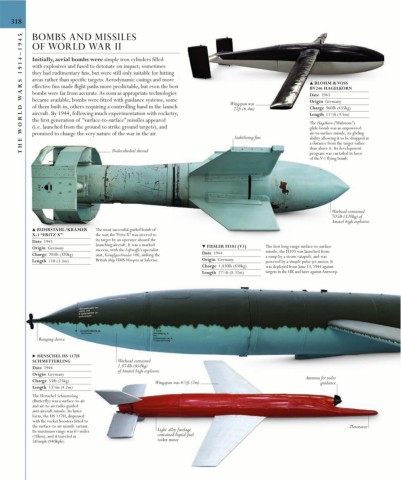
            Initially, aerial bombs were simple iron cylinders filled
            with explosives and fused to detonate on impact; sometimes

         ARS   they had rudimentary fins, but were still only suitable for hitting                             ▲ BLOHM & VOSS
            areas rather than specific targets. Aerodynamic casings and more
            effective fins made flight paths more predictable, but even the best
                                                                                                               BV246 HAGELKORN
            bombs were far from accurate. As soon as appropriate technologies
                                                                                                               Date  1943
         ORLD W  became available, bombs were fitted with guidance systems, some   Wingspan was                Origin  Germany
            of them built-in, others requiring a controlling hand in the launch
                                                                                                               Charge  960lb (435kg)
                                                                                    21ft (6.4m)
            aircraft. By 1944, following much experimentation with rocketry,
                                                                                                               Length  11 ⁄2ft (3.5m)
                                                                                                                       1
            the first generation of  “surface-to-surface” missiles appeared
                                                                                                               The Hagelkorn (“Hailstone”)
         THE W  (i.e. launched from the ground to strike ground targets), and        Stabilizing fins          glide-bomb was an unpowered
                                                                                                               air-to-surface missile, its gliding
            promised to change the very nature of the war in the air.
                                                                                                               ability allowing it to be dropped at
                                                                                                               a distance from the target rather
                                                                                                               than above it. Its development
                                         Dodecahedral shroud
                                                                                                               program was curtailed in favor
                                                                                                               of the V-1 flying bomb.


                                                                                                                       Warhead contained
                                                                                                                       705lb (320kg) of
                                                                                                                       Amatol high explosive
            ▲ RUHRSTAHL/KRAMER     The most successful guided bomb of
            X-1 “FRITZ X”          the war, the “Fritz X” was steered to
            Date  1943             its target by an operator aboard the
                                   launching aircraft. It was a marked
            Origin  Germany        success, with the Luftwaffe’s specialist   ▼ FIESLER FI103 (V1)  The first long-range surface-to-surface
                                                                                                missile, the FI103 was launched from
            Charge  705lb (320kg)  unit, Kampfgeschwader 100, sinking the   Date  1944          a ramp by a steam catapult, and was
            Length  11ft (3.3m)    British ship HMS Warspite at Salerno.   Origin  Germany      powered by a simple pulse-jet motor. It
                                                                         Charge  1,830lb (830kg)  was deployed from June 13, 1944 against
                                                                                1
                                                                         Length  27 ⁄3ft (8.32m)  targets in the UK and later against Antwerp.


               Ranging device


            ▶ HENSCHEL HS 117H
            SCHMETTERLING                  Warhead contained
            Date  1944                     1,874lb (850kg)
                                           of Amatol high explosive
            Origin  Germany
                                                                                                              Antenna for radio
            Charge  55lb (25kg)                         Wingspan was 6½ft (2m)                                     guidance
            Length  13 ⁄4in (4.2m)
                    3
            The Henschel Schmetterling
            (Butterfly) was a surface-to-air
            and air-to-air radio-guided
            anti-aircraft missile. Its latter
            form, the HS 117H, dispensed
            with the rocket boosters fitted to
            the surface-to-air missile variant.                                                                               Detonator
            Its maximum range was 6 ⁄4 miles             Light alloy fuselage
                            1
            (10km), and it traveled at                   contained liquid-fuel
            585mph (940kph).                             rocket motor

