


Page 322 - (DK) Smithsinian - Military History: The Definitive Visual Guide to the Objects of Warfare
P. 322
320    TRANSPORT, RECONNAISSANCE,                                                        Cabin accommodated 18 troops

         1914–1945  AND LIAISON AIRCRAFT


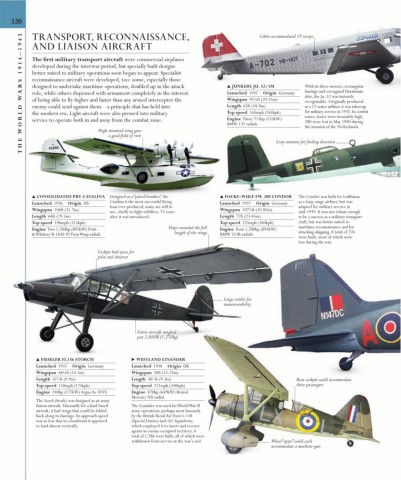
            The first military transport aircraft were commercial airplanes
            developed during the interwar period, but specially built designs

         ARS   better suited to military operations soon began to appear. Specialist   ▲ JUNKERS JU. 52/3M    With its three motors, rectangular
            reconnaissance aircraft were developed, too: some, especially those
            designed to undertake maritime operations, doubled up in the attack
                                                                                                              fuselage and corrugated Duralumin
            role, while others dispensed with armament completely in the interest
                                                                                  Launched  1932     Origin  Germany
                                                                                                              skin, the Ju. 52 was instantly
         ORLD W  of being able to fly higher and faster than any armed interceptor the   Wingspan  95¾ft (29.25m)  recognizable. Originally produced
                                                                                  Length  62ft (18.9m)
            enemy could send against them—a principle that has held into
                                                                                                              as a 17-seater airliner, it was taken up
                                                                                                              for military service in 1935. In combat
                                                                                  Top speed  165mph (265kph)
            the modern era. Light aircraft were also pressed into military
                                                                                                              zones, losses were invariably high;
                                                                                  Engine  Three 715hp (533kW)
            service to operate both in and away from the combat zone.
                                                                                                              280 were lost in May 1940 during
                                                                                  BMW 132 radials
                                                                                                              the invasion of the Netherlands.
         THE W                      High-mounted wing gave                                         Loop antenna for finding direction
                                       a good field of view


            ▲ CONSOLIDATED PBY CATALINA  Designed as a “patrol bomber,” the    ▲ FOCKE-WULF FW. 200 CONDOR  The Condor was built for Lufthansa
            Launched  1936     Origin  US  Catalina is the most successful flying    Launched  1937     Origin  Germany  as a long-range airliner, but was
                                        boat ever produced; many are still in                              adapted for military service in
                                                                                          3
            Wingspan  104ft (31.7m)     use, chiefly to fight wildfires, 75 years   Wingspan  107 ⁄4ft (32.85m)  mid-1939. It was not robust enough
            Length  64ft (19.5m)        after it was introduced.               Length  77ft (23.45m)       to be a success as a military transport
            Top speed  196mph (315kph)                                         Top speed  225mph (360kph)  craft, but was better suited to
            Engine  Two 1,200hp (895kW) Pratt                Flaps extended the full     Engine  Four 1,200hp (895kW)   maritime reconnaissance and for
                                                                                                           attacking shipping. A total of 276
            & Whitney R-1830-92 Twin Wasp radials              length of the wings  BMW 323R radials
                                                                                                           were built, most of which were
                                                                                                           lost during the war.
                                    Cockpit had space for
                                    pilot and observer


                                                                                 Large rudder for
                                                                                 maneuverability


                                                  Entire aircraft weighed
                                                  just 2,800lb (1,270kg)


              ▲ FIESELER FI.156 STORCH          ▶ WESTLAND LYSANDER
              Launched  1937     Origin  Germany  Launched  1938     Origin  UK
              Wingspan  46¾ft (14.3m)           Wingspan  50ft (15.25m)
              Length  32 ⁄2ft (9.9m)            Length  30 ⁄2ft (9.3m)                                     Rear cockpit could accommodate
                                                       1
                     1
              Top speed  110mph (175kph)        Top speed  211mph (340kph)                                 three passengers
              Engine  240hp (177kW) Argus As 10 V8  Engine  870hp (649kW) Bristol
                                                Mercury XX radial
              The Storch (Stork) was designed as an army
              liaison aircraft. Unusually for a land-based   The Lysander was used for World War II
              aircraft, it had wings that could be folded   army operations, perhaps most famously
              back along its fuselage. Its approach speed   by the British Royal Air Force’s 138
              was so low that in a headwind it appeared    (Special Duties) and 161 Squadrons,
              to land almost vertically.        which employed it to insert and recover
                                                agents in enemy-occupied territory. A
                                                total of 1,786 were built, all of which were
                                                withdrawn from service at the war’s end.          Wheel “spats” could each
                                                                                                  accommodate a machine-gun

