


Page 324 - (DK) Smithsinian - Military History: The Definitive Visual Guide to the Objects of Warfare
P. 324
322    COMMUNICATIONS AND CODE-BREAKING

         1914–1945  EQUIPMENT OF WORLD WAR II                                                     Mains plug


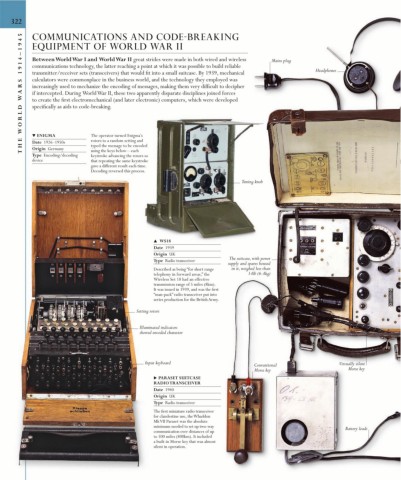
            Between World War I and  World War II great strides were made in both wired and wireless
            communications technology, the latter reaching a point at which it was possible to build reliable

         ARS   transmitter/receiver sets (transceivers) that would fit into a small suitcase. By 1939, mechanical   Headphones
            calculators were commonplace in the business world, and the technology they employed was
            increasingly used to mechanize the encoding of messages, making them very difficult to decipher
            if intercepted. During  World War II, these two apparently disparate disciplines joined forces
         ORLD W  to create the first electromechanical (and later electronic) computers, which were developed
            specifically as aids to code-breaking.


         THE W  ▼ ENIGMA         The operator turned Enigma’s

                                 rotors to a random setting and
            Date  1926–1950s
                                 typed the message to be encoded
            Origin  Germany
            Type  Encoding/decoding   using the keys below—each
                                 keystroke advancing the rotors so
            device               that repeating the same keystroke
                                 gave a different result each time.
                                 Decoding reversed this process.
                                                                                       Tuning knob


                                                        ▲  WS18
                                                        Date  1939
                                                        Origin  UK
                                                        Type  Radio transceiver    The suitcase, with power
                                                                                  supply and spares housed
                                                        Described as being “for short range   in it, weighed less than
                                                        telephony in forward areas,” the   14lb (6.4kg)
                                                        Wireless Set 18 had an effective
                                                        transmission range of 5 miles (8km).
                                                        It was issued in 1939, and was the first
                                                        “man-pack” radio transceiver put into
                                                        series production for the British Army.

                                                  Setting rotors

                                                   Illuminated indicators
                                                   showed encoded character


                                                     Input keyboard                                                       Virtually silent
                                                                                            Conventional
                                                                                            Morse key                        Morse key
                                                        ▶ PARASET SUITCASE
                                                        RADIO TRANSCEIVER
                                                        Date  1940
                                                        Origin  UK
                                                        Type  Radio transceiver
                                                        The first miniature radio transceiver
                                                        for clandestine use, the Whaddon
                                                        Mk VII Paraset was the absolute
                                                        minimum needed to set up two-way                                    Battery leads
                                                        communication over distances of up
                                                        to 500 miles (800km). It included
                                                        a built-in Morse key that was almost
                                                        silent in operation.

