


Page 37 - (DK) Smithsinian - Military History: The Definitive Visual Guide to the Objects of Warfare
P. 37
35

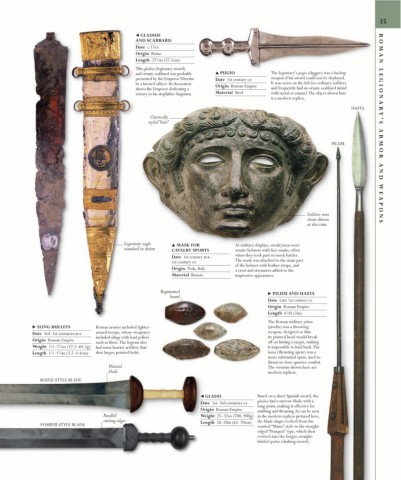
                                                 ◀ GLADIUS                                                                              R
                                                 AND SCABBARD
                                                 Date  c.15ce
                                                 Origin  Rome                                                                           OMAN
                                                 Length  22 ⁄2in (57.5cm)
                                                         1
                                                 This gladius (legionary sword)
                                                 and ornate scabbard was probably   ▲ PUGIO       The legionary’s pugio (dagger) was a backup
                                                 presented by the Emperor Tiberius   Date  1st century ce  weapon if his sword could not be deployed.
                                                 to a favored officer. Its decoration   Origin  Roman Empire  It was worn on the left for ordinary soldiers
                                                 shows the Emperor dedicating a                   and frequently had an ornate scabbard inlaid   LEGIONAR
                                                 victory to his stepfather Augustus.  Material  Steel  with metal or enamel. The object shown here
                                                                                                  is a modern replica.

                                                                                                                              HASTA
                                                      Classically
                                                      styled “hair”


                                                                                                                       PILUM            Y’S ARMOR AND  WEAPONS


                                                                                                               Soldiers were
                                                                                                               clean-shaven
                                                                                                               at this time


                                             Legionary eagle   ▲ MASK FOR            At military displays, cavalrymen wore
                                             standard in shrine  CAVALRY SPORTS      ornate helmets with face masks, often
                                                              Date  1st century bce–  when they took part in mock battles.
                                                              1st century ce         The mask was attached to the main part
                                                                                     of the helmet with leather straps, and
                                                              Origin  Nola, Italy
                                                                                     a crest and streamers added to the
                                                              Material  Bronze       impressive appearance.
                                                          Regimental                            ▶ PILUM AND HASTA
                                                              brand
                                                                                                Date  Late 1st century ce
                                                                                                Origin  Roman Empire
                                                                                                Length  6 ⁄2ft (2m)
                                                                                                       1
                                                                                                The Roman military pilum
            ▶ SLING BULLETS        Roman armies included lighter-                               (javelin) was a throwing
            Date  3rd–1st centuries bce  armed troops, whose weaponry                           weapon, designed so that
                                   included slings with lead pellets                            its pointed head would break
            Origin  Roman Empire
                                   such as these. The legions also                              off on hitting a target, making
                   1
            Weight  1 ⁄4–2 ⁄4oz (37.5–64.5g)  had some heavier artillery that                   it impossible to hurl back. The
                      1
            Length  1 ⁄4–1 ⁄4in (3.2–4.4cm)  shot larger, pointed bolts.                        hasta (thrusting spear) was a
                      3
                   1
                                                                                                more substantial spear, used to
                                                                                                thrust in close-quarter combat.
                                        Waisted                                                 The versions shown here are
                                        blade                                                   modern replicas.
               MAINZ-STYLE BLADE
                                                                        ◀ GLADII             Based on a short Spanish sword, the
                                                                                             gladius had a narrow blade with a
                                                                        Date  1st–3rd centuries ce
                                                                                             long point, making it effective for
                                                                        Origin  Roman Empire  stabbing and thrusting. As can be seen
                                      Parallel                          Weight  25–32oz (700–900g) in the modern replicas pictured here,
                                      cutting edges                     Length  26–28in (65–70cm)  the blade shape evolved from the
               POMPEII-STYLE BLADE                                                           waisted “Mainz” style to the straight-
                                                                                             edged “Pompeii” type, which then
                                                                                             evolved into the longer, straight-
                                                                                             bladed spatha (slashing sword).

