


Page 39 - (DK) Smithsinian - Military History: The Definitive Visual Guide to the Objects of Warfare
P. 39
37

                                                                                                          ◀ THE SIEGE OF MASADA
            the besieged troops, provided the attackers with                                              To take possession of the inaccessible
            access to the walls for artillery points, and formed                                          mountain fort of Masada, the last
            a platform for a final assault.                                                               stronghold of the Jewish Revolt,
              More than the surviving remains of their forts,                                             in 73ce, the Romans had to build
            the finest testament to the Romans’ skills in military                                        a counterwall with towers and a
                                                                                                          gigantic assault ramp on which to
            engineering is arguably the vast network of roads—                                            mount a battering ram. The ramp
            some 120,000km (75,000 miles) long—they built                                                 was 738ft (225m) long and up to   THE ENGINEERING OF R
            to consolidate their rule. The first was the Via Appia,                                       656ft (200m) wide.
            begun in 331BCE, which initially ran from Rome
            to Capua. Main roads linked the towns, making it
            possible to move troops quickly and to operate an
            efficient postal network. Military roads ran behind
            important frontiers, as in Britain and Germany.
            Roman roads were normally straight, regardless of
            local topography, and were carried over rivers and
            marshes by bridges or viaducts. Their durability
            owed much to their excellent construction, which
            involved a foundation of coarse gravel laid beneath
            layers of finer gravel, with large blocks of basalt                                                                         OMAN CONQ
            added on top to form the pavement.

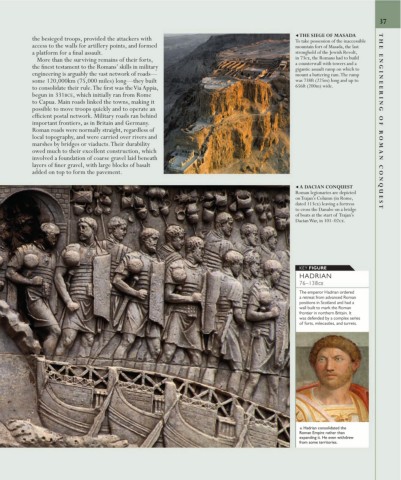
                                                                                                          ◀ A DACIAN CONQUEST
                                                                                                          Roman legionaries are depicted
                                                                                                          on Trajan’s Column (in Rome,    UEST
                                                                                                          dated 113ce) leaving a fortress
                                                                                                          to cross the Danube on a bridge
                                                                                                          of boats at the start of  Trajan’s
                                                                                                          Dacian War, in 101–02ce.


                                                                                                            KEY FIGURE
                                                                                                            HADRIAN
                                                                                                            76–138ce
                                                                                                            The emperor Hadrian ordered
                                                                                                            a retreat from advanced Roman
                                                                                                            positions in Scotland and had a
                                                                                                            wall built to mark the Roman
                                                                                                            frontier in northern Britain. It
                                                                                                            was defended by a complex series
                                                                                                            of forts, milecastles, and turrets.


                                                                                                            ▲ Hadrian consolidated the
                                                                                                            Roman Empire rather than
                                                                                                            expanding it. He even withdrew
                                                                                                            from some territories.

