


Page 38 - (DK) Smithsinian - Military History: The Definitive Visual Guide to the Objects of Warfare
P. 38
36

         CE   KEY EVENTS                 KEY DEVELOPMENT
              146bce–124ce
         O 500  ◼ c.146bce  Work begins on the   THE ENGINEERING OF

              Via Egnatia, a road that will enable
                                         ROMAN CONQUEST
              Roman armies to access most of
         ORDS   T  the Balkans from Italy.  The Roman legionaries were not only excellent in combat—they were
              ◼ 134–133bce  Roman forces,
              led by Scipio Africanus, besiege the
              Celtiberian stronghold of Numantia,
                                         also highly skilled military engineers, who were called upon to build
              surrounding it with fortifications
         AND SW  (known as circumvallations) and   forts, roads, and siege-works throughout the empire.
              attacking it with siege towers. The
              settlement falls after 16 months.
                                         A Roman legionary’s entrenching tools, it was
                                                                                        If an enemy fort could not be taken by stealth, it had
                                         said, were as dear to him as his sword. When on
              ◼ 52bce  Julius Caesar traps
                                                                                        to be surrounded and starved out or, as a last resort,
              Vercingetorix, leader of the Gallic
         TS   Revolt, at Alesia. Roman engineers   campaign, legionaries built a marching camp every   stormed. To isolate an enemy position, the Romans
                                         evening, using a formulaic design that allowed
                                                                                        built complex siege-works of ramparts, often with
              build complex siege-works,
              preventing relief forces from
                                                                                        towers from which to fire heavy catapults. At the
                                         them to organize encampments for up to 5,000
         CHARIO  ◼ 73ce  Flavius Silva uses his   usually rectangular, surrounded by a V-shaped   of 35km (55 miles) of ramparts that hemmed in
              coming to the defenders’ aid.
                                         soldiers. Sited on level ground, the camps were
                                                                                        Siege of Alesia, Julius Caesar oversaw the building
              engineers of the Tenth Legion to
                                                                                        Gaulish chieftain Vercingetorix, and cut off supplies.
                                         ditch and an earth rampart bristling with wooden
              subdue the mountain fort of Masada.
                                         spikes that the legionaries carried with them.
                                                                                        Vast earthworks called assault ramps intimidated
              ◼ 122–24ce  Hadrian’s Wall   Once an area was conquered, more permanent
              becomes the Romans’ most complex   forts were built (see p.38), also based on this
              border system. It is 73 miles (117km)   “playing-card design”—so-called because they had
              long and punctuated by forts.
                                         rounded corners. Each fort had four main gates, one
                                         of which (the porta praetoria) faced enemy territory;
                                         a network of roads; and a central block of buildings
                                         that contained the praetorium (commander’s house),
                                         the principia (headquarters), and a shrine for the
                                         legionary standards.
            ▼ LEGION INSIGNIA             Forts were built in various sizes, to accommodate
            Imperial legions were proud of
            their identity. This plaque shows    either whole legions or smaller auxiliary cohorts
            the emblem of the Twentieth Legion,   (around 500 men). They sometimes formed part
            which took part in suppressing the   of complex linear defenses, or even walls (such
            Iceni revolt in Britain (60–61ce).
                                         as Hadrian’s Wall in Britain). Over time, the earth
                                         and turf of many of the original forts were replaced
                                         with stone, and, during the later empire, the walls
                                         were stronger and had projecting corner towers
                                         allowing missile cross-fire. These developments
                                         reflected the fact that the forts had become places
                                         the army needed to defend, rather than bases from
                                         which to dominate the surrounding territory.
                                         ROMAN SIEGES
                                         The legionaries put their skill at constructing
                                         fortifications and ramparts to good offensive
                                         effect in siege warfare, as they encountered enemy
                                         bastions as diverse as the hill-forts of Gaul and
                                         Britain, and the elaborate walled towns of Judaea.


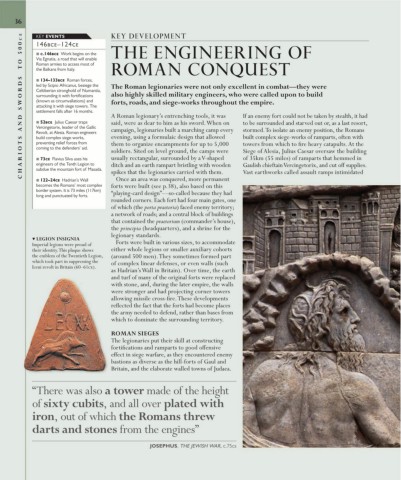
            “There was also a tower made of the height
            of sixty cubits, and all over plated with

            iron, out of which the Romans threw

            darts and stones from the engines”


                                                      JOSEPHUS, THE JEWISH WAR, c.75ce

