


Page 35 - (DK) Smithsinian - Military History: The Definitive Visual Guide to the Objects of Warfare
P. 35
33

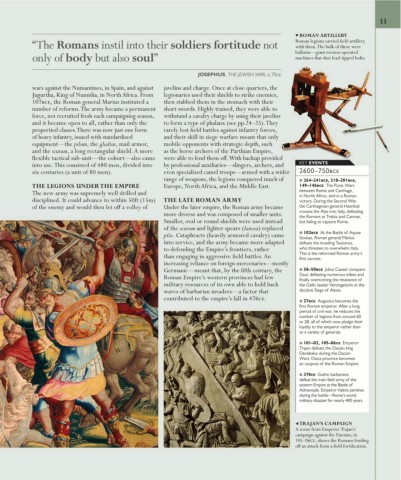
                                                                                                          ▼ ROMAN ARTILLERY
            “The Romans instil into their soldiers fortitude not                                          Roman legions carried field artillery
                                                                                                          with them. The bulk of these were
                                                                                                          ballistas—giant torsion operated
            only of body but also soul”                                                                   machines that shot lead-tipped bolts.


                                                                        JOSEPHUS, THE JEWISH WAR, c.75ce

            wars against the Numantines, in Spain, and against   javelins and charge. Once at close quarters, the
            Jugurtha, King of Numidia, in North Africa. From   legionaries used their shields to strike enemies,
            107bce, the Roman general Marius instituted a   then stabbed them in the stomach with their
            number of reforms. The army became a permanent  short swords. Highly trained, they were able to
            force, not recruited fresh each campaigning season,   withstand a cavalry charge by using their javelins
            and it became open to all, rather than only the   to form a type of phalanx (see pp.24–25). They
            propertied classes.There was now just one form    rarely lost field battles against infantry forces,
            of heavy infantry, issued with standardized    and their skill in siege warfare meant that only
            equipment—the pilum, the gladius, mail armor,   mobile opponents with strategic depth, such
            and the scutum, a long rectangular shield. A more   as the horse archers of the Parthian Empire,
            flexible tactical sub-unit—the cohort—also came   were able to fend them off. With backup provided
            into use. This consisted of 480 men, divided into   by professional auxiliaries—slingers, archers, and   KEY EVENTS
            six centuries (a unit of 80 men).              even specialized camel troops—armed with a wider   2600–750bce
                                                           range of weapons, the legions conquered much of
                                                                                                            ◼ 264–241bce, 218–201bce,
            THE LEGIONS UNDER THE EMPIRE                   Europe, North Africa, and the Middle East.       149–146bce  The Punic Wars
            The new army was supremely well drilled and                                                     between Rome and Carthage,
                                                                                                            in North Africa, end in a Roman
            disciplined. It could advance to within 50ft (15m)   THE LATE ROMAN ARMY                        victory. During the Second War,
            of the enemy and would then let off a volley of   Under the later empire, the Roman army became   the Carthaginian general Hannibal
                                                           more diverse and was composed of smaller units.   crosses the Alps into Italy, defeating
                                                                                                            the Romans at Trebia and Cannae,
                                                           Smaller, oval or round shields were used instead    but failing to capture Rome.
                                                           of the scutum and lighter spears (lancea) replaced
                                                           pila. Cataphracts (heavily armored cavalry) came   ◼ 102bce  At the Battle of Aquae
                                                                                                            Sextiae, Roman general Marius
                                                           into service, and the army became more adapted   defeats the invading Teutones,
                                                           to defending the Empire’s frontiers, rather      who threaten to overwhelm Italy.
                                                           than engaging in aggressive field battles. An    This is the reformed Roman army’s
                                                                                                            first success.
                                                           increasing reliance on foreign mercenaries—mostly
                                                           Germanic—meant that, by the fifth century, the   ◼ 58–50bce  Julius Caesar conquers
                                                           Roman Empire’s western provinces had few         Gaul, defeating numerous tribes and
                                                                                                            finally overcoming the resistance of
                                                           military resources of its own able to hold back   the Gallic leader Vercingetorix at the
                                                           waves of barbarian invaders—a factor that        decisive Siege of Alesia.
                                                           contributed to the empire’s fall in 476ce.
                                                                                                            ◼ 27bce  Augustus becomes the
                                                                                                            first Roman emperor. After a long
                                                                                                            period of civil war, he reduces the
                                                                                                            number of legions from around 60
                                                                                                            to 28, all of which now pledge their
                                                                                                            loyalty to the emperor rather than
                                                                                                            to a variety of generals.

                                                                                                            ◼ 101–02, 105–06ce  Emperor
                                                                                                            Trajan defeats the Dacian king
                                                                                                            Decebalus during the Dacian
                                                                                                            Wars. Dacia province becomes
                                                                                                            an outpost of the Roman Empire.

                                                                                                            ◼ 378ce  Gothic barbarians
                                                                                                            defeat the main field army of the
                                                                                                            eastern Empire at the Battle of
                                                                                                            Adrianople. Emperor Valens perishes
                                                                                                            during the battle—Rome’s worst
                                                                                                            military disaster for nearly 400 years.


                                                                                                          ◀ TRAJAN’S CAMPAIGN
                                                                                                          A scene from Emperor  Trajan’s
                                                                                                          campaign against the Dacians, in
                                                                                                          105–06CE, shows the Romans fending
                                                                                                          off an attack from a field fortification.

