


Page 62 - (DK) Smithsinian - Military History: The Definitive Visual Guide to the Objects of Warfare
P. 62
60      KEY FORCE                  KEY DEVELOPMENT

         WMEN 500–1500  KNIGHTS TEMPLAR  ARMORED CAVALRY

              1119–1312

                                         IN MEDIEVAL EUROPE
              Founded in Jerusalem during the
              Crusades, the Knights Templar were
              a military organization dedicated to
              the defense of Christianity. While
              following religious rules of conduct,
                                         The armored knight appeared as the key figure in western European
              the Templars were also elite fighters
              forces. They took part in the failed
                                         this elite warrior evolved constantly in search of better protection and
         AND BO  in the Crusader wars against Muslim   warfare around the 11th–12th centuries. The armor and weaponry of
              defense of the last of the Crusader
              kingdoms in 1291, after which they
                                         more effective attack.
              were suppressed by the papacy
              and their wealth was plundered by
                                         Heavily armored cavalry first developed in
                                                                                        prevented a knight from mounting his horse
              King Philip IV of France.
                                         Asia, and reached Europe through the Roman
                                                                                        unaided or fighting on foot: its main disadvantage
         KNIGHTS                         Empire’s contacts with Sassanid Persia from the   was that it caused overheating. Both armor and
                                         3rd century ce. As a result, the Byzantine Empire
                                                                                        helmets continued to evolve in terms of the skill
                                         fielded cataphracts (early heavy cavalry) as its shock
                                                                                        of manufacture and complexity of design and
                                                                                        decoration, reaching a pinnacle of elaboration
                                         battlefield force. Both the cataphract and his horse
                                         were fully covered by scale armor, which was
                                                                                        in the 16th century, by which time display was
                                         made of overlapping metal plates. His main weapon  as important a function as practical defense.
                                         was a long lance. Sustaining such a warrior required
                                         a supply of specially bred large horses, skilled   KNIGHTS IN COMBAT
                                         metalworkers, and the resources to pay for these.   The evolution of armor also led to changes
                                                                                        in weaponry. The ideal knightly combat—rarely
                                         DEVELOPMENTS IN ARMOR                          encountered outside jousting tournaments—
                                         Cavalry in western Europe evolved independently,   started with a charge with couched lance (held
                                         but was influenced by the Byzantine example.   in the attacking position), followed by a close-
                                         Mounted forces had adopted the lance by the    quarters mêlée. In the era of mail, knights hacked
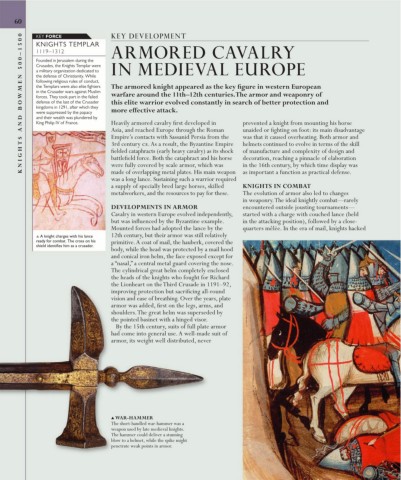
              ▲ A knight charges with his lance   12th century, but their armor was still relatively
              ready for combat. The cross on his   primitive. A coat of mail, the hauberk, covered the
              shield identifies him as a crusader.
                                         body, while the head was protected by a mail hood
                                         and conical iron helm, the face exposed except for
                                         a “nasal,” a central metal guard covering the nose.
                                         The cylindrical great helm completely enclosed
                                         the heads of the knights who fought for Richard
                                         the Lionheart on the Third Crusade in 1191–92,
                                         improving protection but sacrificing all-round
                                         vision and ease of breathing. Over the years, plate
                                         armor was added, first on the legs, arms, and
                                         shoulders. The great helm was superseded by
                                         the pointed basinet with a hinged visor.
                                          By the 15th century, suits of full plate armor
                                         had come into general use. A well-made suit of
                                         armor, its weight well distributed, never


                                         ▲ WAR-HAMMER
                                         The short-handled war-hammer was a
                                         weapon used by late medieval knights.
                                         The hammer could deliver a stunning
                                         blow to a helmet, while the spike might
                                         penetrate weak points in armor.

