


Page 59 - (DK) Smithsinian - Military History: The Definitive Visual Guide to the Objects of Warfare
P. 59
57


                                                   Silver-incised                                                                       ANGLO-SAXONS AND
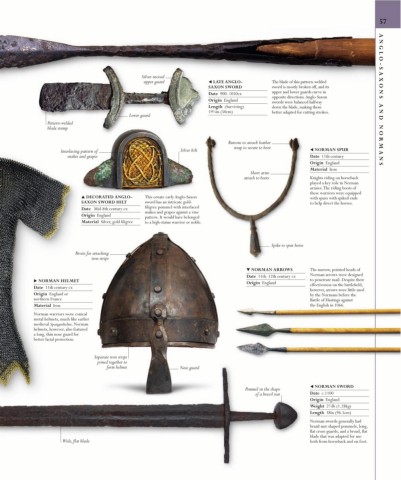
                                                    upper guard            ◀ LATE ANGLO-          The blade of this pattern-welded
                                                                           SAXON SWORD            sword is mostly broken off, and its
                                                                           Date  900–1050ce       upper and lower guards curve in
                                                                                                  opposite directions. Anglo-Saxon
                                                                           Origin  England        swords were balanced halfway
                                                                           Length  (Surviving)    down the blade, making them
                                                                           19 ⁄4in (50cm)         better adapted for cutting strokes.
                                                                             3
                                               Lower guard
                  Pattern-welded
                  blade stump

                                                                                  Buttons to attach leather
                                                                                    strap to secure to boot                             NORMANS
                       Interlacing pattern of                    Silver hilt                                    ◀ NORMAN SPUR
                         snakes and grapes                                                                      Date  11th century
                                                                                                                Origin  England
                                                                                                                Material  Iron
                                                                                          Short arms
                                                                                        attach to boots         Knights riding on horseback
                                                                                                                played a key role in Norman
                                                                                                                armies. The riding boots of
                                                                                                                these warriors were equipped
                              ▲ DECORATED ANGLO-     This ornate early Anglo-Saxon                              with spurs with spiked ends
                              SAXON SWORD HILT       sword has an intricate gold-                               to help direct the horses.
                              Date   Mid-8th century ce  filigree pommel with interlaced
                                                     snakes and grapes against a vine
                              Origin  England        pattern. It would have belonged
                              Material  Silver, gold filigree  to a high-status warrior or noble.


                                                                                                  Spike to spur horse
                            Rivets for attaching
                                  iron strips
                                                                                         ▼ NORMAN ARROWS        The narrow, pointed heads of
                                                                                         Date  11th–12th century ce  Norman arrows were designed
             ▶ NORMAN HELMET                                                             Origin  England        to penetrate mail. Despite their
             Date  11th century ce                                                                              effectiveness on the battlefield,
                                                                                                                however, arrows were little used
             Origin  England or                                                                                 by the Normans before the
             northern France                                                                                    Battle of Hastings against
             Material  Iron                                                                                     the English in 1066.
             Norman warriors wore conical
             metal helmets, much like earlier
             medieval Spangenhelms. Norman
             helmets, however, also featured
             a long, thin nose guard for
             better facial protection.


                                  Separate iron strips
                                    joined together to
                                       form helmet               Nose guard


                                                                                                                ◀ NORMAN SWORD
                                                                                        Pommel in the shape
                                                                                            of a brazil nut     Date  c.1100
                                                                                                                Origin  England
                                                                                                                      3
                                                                                                                Weight  2 ⁄4lb (1.28kg)
                                                                                                                Length  38in (96.5cm)
                                                                                                                Norman swords generally had
                                                                                                                brazil-nut-shaped pommels, long,
                                                                                                                flat cross-guards, and a broad, flat
                                                                                                                blade that was adapted for use
                       Wide, flat blade                                                                         both from horseback and on foot.

