


Page 60 - (DK) Smithsinian - Military History: The Definitive Visual Guide to the Objects of Warfare
P. 60
58    DARK AGES INVASION FORCE

         WMEN 500–1500  THE BATTLE


            OF HASTINGS


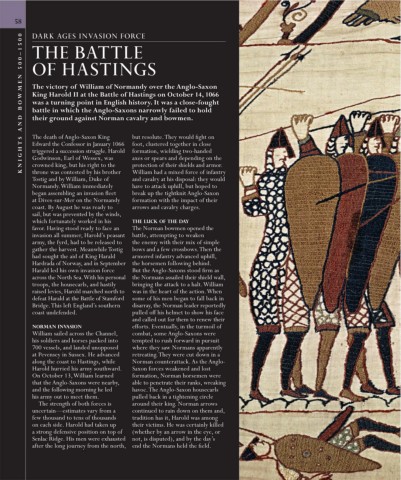
            The victory of  William of Normandy over the Anglo-Saxon


            was a turning point in English history. It was a close-fought
         AND BO  King Harold II at the Battle of Hastings on October 14, 1066
            battle in which the Anglo-Saxons narrowly failed to hold
            their ground against Norman cavalry and bowmen.


         KNIGHTS   The death of Anglo-Saxon King   but resolute. They would fight on
            Edward the Confessor in January 1066  foot, clustered together in close
            triggered a succession struggle. Harold  formation, wielding two-handed
                                                axes or spears and depending on the
            Godwinson, Earl of  Wessex, was
            crowned king, but his right to the
                                                protection of their shields and armor.
            throne was contested by his brother
                                                and cavalry at his disposal: they would
            Tostig and by William, Duke of      William had a mixed force of infantry
            Normandy. William immediately       have to attack uphill, but hoped to
            began assembling an invasion fleet    break up the tightknit Anglo-Saxon
            at Dives-sur-Mer on the Normandy    formation with the impact of their
            coast. By August he was ready to    arrows and cavalry charges.
            sail, but was prevented by the winds,
            which fortunately worked in his     THE LUCK OF THE DAY
            favor. Having stood ready to face an   The Norman bowmen opened the
            invasion all summer, Harold’s peasant  battle, attempting to weaken
            army, the fyrd, had to be released to   the enemy with their mix of simple
            gather the harvest. Meanwhile Tostig   bows and a few crossbows. Then the
            had sought the aid of King Harald   armored infantry advanced uphill,
            Hardrada of Norway, and in September  the horsemen following behind.
            Harald led his own invasion force   But the Anglo-Saxons stood firm as
            across the North Sea. With his personal  the Normans assailed their shield wall,
            troops, the housecarls, and hastily   bringing the attack to a halt. William
            raised levies, Harold marched north to  was in the heart of the action. When
            defeat Harald at the Battle of Stamford  some of his men began to fall back in
            Bridge. This left England’s southern   disarray, the Norman leader reportedly
            coast undefended.                   pulled off his helmet to show his face
                                                and called out for them to renew their
            NORMAN INVASION                     efforts. Eventually, in the turmoil of
            William sailed across the Channel,    combat, some Anglo-Saxons were
            his soldiers and horses packed into   tempted to rush forward in pursuit
            700 vessels, and landed unopposed    where they saw Normans apparently
            at Pevensey in Sussex. He advanced   retreating. They were cut down in a
            along the coast to Hastings, while   Norman counterattack. As the Anglo-
            Harold hurried his army southward.   Saxon forces weakened and lost
            On October 13, William learned      formation, Norman horsemen were
            that the Anglo-Saxons were nearby,   able to penetrate their ranks, wreaking
            and the following morning he led    havoc. The Anglo-Saxon housecarls
            his army out to meet them.          pulled back in a tightening circle
               The strength of both forces is   around their king. Norman arrows
            uncertain—estimates vary from a     continued to rain down on them and,
            few thousand to tens of thousands    tradition has it, Harold was among
            on each side. Harold had taken up    their victims. He was certainly killed
            a strong defensive position on top of   (whether by an arrow in the eye, or
            Senlac Ridge. His men were exhausted  not, is disputed), and by the day’s
            after the long journey from the north,  end the Normans held the field.

