


Page 92 - (DK) Smithsinian - Military History: The Definitive Visual Guide to the Objects of Warfare
P. 92
90      KEY EVENTS                 KEY DEVELOPMENT

         WMEN 500–1500  7th–15th century  ARAB AND


              ◼ 634–36ce  The Arab armies
              launch their campaigns of conquest,
                                         TURKISH CONFLICT
              with decisive defeats of the armies
              of the Persian Sassanid and Christian
              Byzantine Empires.
              ◼ 648ce  In possession of Egypt,
                                         From the 7th century CE onward, Arab and Turkish armies dominated large
              the Arabs begin construction of a
                                         were a combination of tactical subtlety, fighting spirit, and the skilled use of
              a Mediterranean naval power.
         AND BO  fleet of war galleys, making them    areas of Asia, Africa, and Europe. These Muslim forces’ military achievements
                                         available weapons technology.
              ◼ 9th century ce  The Arab
              Abbasid caliphs, ruling from Baghdad,
                                                                                        Arabs, they proved adept at absorbing useful
                                         The founding of Islam by the prophet Muhammad,
              make Turkish slave soldiers the hub
              of their military forces.
                                                                                        technology and tactics from settled civilizations.
                                         in Arabia in the early 7th century ce, had dramatic
         KNIGHTS   ◼ 1071  Seljuk Turkish horsemen   military consequences as well as religious   During the 10th century, they began to convert
                                         significance. In the century from 634ce onward,
                                                                                        to Islam and some groups, such as the Ghaznavids
              outmaneuver and destroy a
              Byzantine army at Manzikert.
                                                                                        and the Seljuks, carved out empires for themselves,
                                         Muslim Arab armies embarked on a series of
                                         campaigns of conquest that swept east as far as
                                                                                        as Arab power fragmented and declined. In 1071,
              ◼ 1095–1291  The Crusades
              ignite prolonged combat between
              Muslim and Christian forces in
                                          At first, the Arab military forces depended on
                                                                                        crushing defeat on a Byzantine army at Manzikert
              the eastern Mediterranean.  Afghanistan and west to the Iberian peninsula.   combined Seljuk forces led by Alp Arslan inflicted a
                                         camels to carry foot soldiers and supplies. But they   (in modern-day Turkey)—a heavy setback, from
              ◼ 1396  The Ottoman Turkish   quickly proved adept at absorbing new technology   which the Byzantine Empire never fully recovered.
              army of Sultan Bayezid shows    and tactics from the states they defeated. Soon,   The Christian invasions of the eastern
              its superiority to heavily armored
              European knights at the battle    cavalry was the outstanding feature of Arab armies—  Mediterranean, known as the Crusades, brought
              of Nicopolis.              including both light mounted bowmen and heavier   various Muslim armies into combat with forces
                                         armored cavalry with spears and lances. The
              ◼ 1453  The Ottomans take
              Constantinople, using heavy    craftsmen of the cities they captured, meanwhile,
              cannon to batter the       manufactured high-quality swords; “damascene”
              previously impregnable     steel, from Damascus in Syria, for example, was
              city walls.
                                         renowned for its resilience and cutting edge. Not
                                         previously a seafaring people, after conquering the
                                         ports of Egypt and Palestine, the Arabs developed a
                                          navy using the expertise of shipbuilders and sailors.
                                          They also adopted siege machines and tactics from
                                          the conquered Sassanid Persian Empire, and the
                                          Byzantine Empire, which they did not conquer.
                                          Muslim states later efficiently adopted such
                                          advanced siege engines as the counterweight
                                          trebuchet from their Christian enemies.
                                               TURKISH FORCES
                                               The migratory Turkish peoples, who
                                              inhabited large areas of central Asia, became
                                             a source of military manpower for Arab states
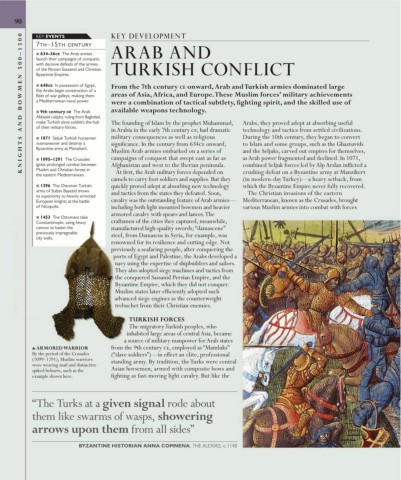
            ▲ ARMORED WARRIOR            from the 9th century ce, employed as “Mamluks”
            By the period of the Crusades   (“slave soldiers”)—in effect an elite, professional
            (1099–1291), Muslim warriors    standing army. By tradition, the Turks were central
            were wearing mail and distinctive   Asian horsemen, armed with composite bows and
            spiked helmets, such as the
            example shown here.          fighting as fast-moving light cavalry. But like the


            “The Turks at a given signal rode about

            them like swarms of wasps, showering

            arrows upon them from all sides”


                             BYZANTINE HISTORIAN ANNA COMNENA, THE ALEXIAD, c.1140

