


Page 94 - (DK) Smithsinian - Military History: The Definitive Visual Guide to the Objects of Warfare
P. 94
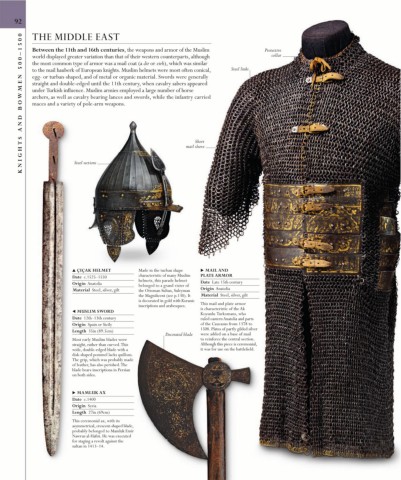
92    THE MIDDLE EAST

         WMEN 500–1500  Between the 11th and 16th centuries, the weapons and armor of the Muslim   Steel links  Protective


                                                                                                  collar
            world displayed greater variation than that of their western counterparts, although
            the most common type of armor was a mail coat (a dir or zirh), which was similar
            to the mail hauberk of European knights. Muslim helmets were most often conical,
            egg- or turban-shaped, and of metal or organic material. Swords were generally
            straight and double-edged until the 11th century, when cavalry sabers appeared
            under  Turkish influence. Muslim armies employed a large number of horse

         AND BO  archers, as well as cavalry bearing lances and swords, while the infantry carried
            maces and a variety of pole-arm weapons.


         KNIGHTS           Steel sections                          mail sleeve
                                                                      Short


                           ▲ ÇIÇAK HELMET         Made in the turban shape   ▶ MAIL AND
                           Date  c.1525–1550      characteristic of many Muslim   PLATE ARMOR
                                                  helmets, this parade helmet
                           Origin  Anatolia                             Date  Late 15th century
                                                  belonged to a grand vizier of
                           Material  Steel, silver, gilt  the Ottoman Sultan, Suleyman    Origin  Anatolia
                                                  the Magnificent (see p.130). It    Material  Steel, silver, gilt
                                                  is decorated in gold with Koranic
                                                  inscriptions and arabesques.  This mail and plate armor
                           ◀ MUSLIM SWORD                               is characteristic of the Ak
                                                                        Koyunlu  Turkomans, who
                           Date  12th–13th century                      ruled eastern Anatolia and parts
                           Origin  Spain or Sicily                      of the Caucasus from 1378 to
                                                                        1508. Plates of partly gilded silver
                           Length  35in (89.5cm)
                                                            Decorated blade  were added on a base of mail
                           Most early Muslim blades were                to reinforce the central section.
                           straight, rather than curved. This           Although this piece is ceremonial,
                           wide, double-edged blade with a              it was for use on the battlefield.
                           disk-shaped pommel lacks quillons.
                           The grip, which was probably made
                           of leather, has also perished. The
                           blade bears inscriptions in Persian
                           on both sides.


                           ▶ MAMLUK AX
                           Date  c.1400
                           Origin  Syria
                           Length  27in (69cm)
                           This ceremonial ax, with its
                           asymmetrical, crescent-shaped blade,
                           probably belonged to Mamluk Emir
                           Nawruz al-Hafizi. He was executed
                           for staging a revolt against the
                           sultan in 1413–14.

