


Page 93 - (DK) Smithsinian - Military History: The Definitive Visual Guide to the Objects of Warfare
P. 93
91


            from western Europe between the late 11th
            and late 13th centuries. Although more lightly
            armored than the Christian knights, forces led
            by Saladin, Kurdish ruler of Egypt and Syria,
            and Baybars, Mamluk sultan of Egypt, inflicted a
            number of defeats on crusaders’ heavily armored
            bodies of knights. The Muslim forces’ flexible                                                                              ARAB AND  TURKISH
            tactics were based on rapid maneuvers, such
            as hit-and-run attacks by light horsemen, and
            they closed in for hand-to-hand combat only
            once they had gained the upper hand.

            THE RISE OF THE OTTOMANS
            During the course of the 14th century, a band
            of Turkish warriors established themselves in
            Anatolia, at the heart of the old Byzantine Empire.                                                                         CONFLICT
            Initially led by Sultan Osman, they became known
            as the Ottoman Turks. Their military successes
            soon carried them deep into southeastern Europe.
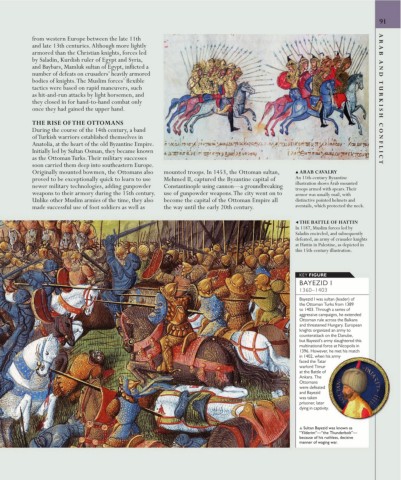
            Originally mounted bowmen, the Ottomans also   mounted troops. In 1453, the Ottoman sultan,   ▲ ARAB CAVALRY
            proved to be exceptionally quick to learn to use   Mehmed II, captured the Byzantine capital of   An 11th-century Byzantine
            newer military technologies, adding gunpowder   Constantinople using cannon—a groundbreaking   illustration shows Arab mounted
                                                                                                          troops armed with spears. Their
            weapons to their armory during the 15th century.   use of gunpowder weapons. The city went on to   armor was usually mail, with
            Unlike other Muslim armies of the time, they also   become the capital of the Ottoman Empire all    distinctive pointed helmets and
            made successful use of foot soldiers as well as   the way until the early 20th century.       aventails, which protected the neck.


                                                                                                          ◀ THE BATTLE OF HATTIN
                                                                                                          In 1187, Muslim forces led by
                                                                                                          Saladin encircled, and subsequently
                                                                                                          defeated, an army of crusader knights
                                                                                                          at Hattin in Palestine, as depicted in
                                                                                                          this 15th-century illustration.


                                                                                                            KEY FIGURE
                                                                                                            BAYEZID I
                                                                                                            1360–1403
                                                                                                            Bayezid I was sultan (leader) of
                                                                                                            the Ottoman Turks from 1389
                                                                                                            to 1403. Through a series of
                                                                                                            aggressive campaigns, he extended
                                                                                                            Ottoman rule across the Balkans
                                                                                                            and threatened Hungary. European
                                                                                                            knights organized an army to
                                                                                                            counterattack on the Danube,
                                                                                                            but Bayezid’s army slaughtered this
                                                                                                            multinational force at Nicopolis in
                                                                                                            1396. However, he met his match
                                                                                                            in 1402, when his army
                                                                                                            faced the Tatar
                                                                                                            warlord Timur
                                                                                                            at the Battle of
                                                                                                            Ankara. The
                                                                                                            Ottomans
                                                                                                            were defeated
                                                                                                            and Bayezid
                                                                                                            was taken
                                                                                                            prisoner, later
                                                                                                            dying in captivity.


                                                                                                            ▲ Sultan Bayezid was known as
                                                                                                            “Yilderim”—“the Thunderbolt”—
                                                                                                            because of his ruthless, decisive
                                                                                                            manner of waging war.

