


Page 134 - (DK Eyewitness) Travel Guide - India
P. 134
132 DELHI & THE NOR TH
o Manali
Kullu district. 210 km (130 miles) N
of Shimla. * 6,300. @ n The Mall,
(01902) 253 531. ( daily. _ Winter
Carnival (Jan), Dhungri Mela (May).
Picturesque Manali, situated
along the west bank of the
Beas river, is a prime destination
for visitors, offering a variety
of scenic walks and treks
through dense forests. Though
hotels and shops now overrun
downtown Manali, its environs
still retain much of the natural
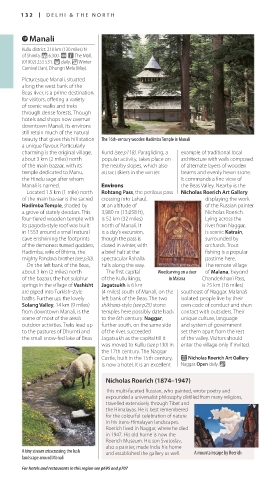
beauty that gives this hill station The 16th-century wooden Hadimba Temple in Manali
a unique flavour. Particularly
charming is the original village, Kund (see p118). Paragliding, a example of traditional local
about 3 km (2 miles) north popular activity, takes place on architecture with walls composed
of the main bazaar, with its the nearby slopes, which also of alternate layers of wooden
temple dedicated to Manu, attract skiers in the winter. beams and evenly hewn stone.
the Hindu sage after whom It commands a fine view of
Manali is named. Environs the Beas Valley. Nearby is the
Located 1.5 km (1 mile) north Rohtang Pass, the perilous pass Nicholas Roerich Art Gallery
of the main bazaar is the sacred crossing into Lahaul, displaying the work
Hadimba Temple, shaded by at an altitude of of the Russian painter
a grove of stately deodars. This 3,980 m (13,058 ft), Nicholas Roerich.
four-tiered wooden temple with is 52 km (32 miles) Lying across the
its pagoda-style roof was built north of Manali. It river from Naggar,
in 1553 around a small natural is a day’s excursion, is scenic Katrain,
cave enshrining the footprints though the pass is surrounded by
of the demoness turned goddess, closed in winter, with orchards. Trout
Hadimba, wife of Bhima, the a brief halt at the fishing is a popular
mighty Pandava brother (see p30). spectacular Rahalla pastime here.
On the left bank of the Beas, Falls along the way. The remote village
about 3 km (2 miles) north The first capital Woodcarving on a door of Malana, beyond
of the bazaar, the hot sulphur of the Kullu kings, in Malana Chanderkhani Pass,
springs in the village of Vashisht Jagatsukh is 6 km is 25 km (16 miles)
are piped into Turkish-style (4 miles) south of Manali, on the southeast of Naggar. Malana’s
baths. Further up, the lovely left bank of the Beas. The two isolated people live by their
Solang Valley, 14 km (9 miles) shikhara-style (see p25) stone own code of conduct and shun
from downtown Manali, is the temples here possibly date back contact with outsiders. Their
scene of most of the area’s to the 6th century. Naggar, unique culture, language
outdoor activities. Treks lead up further south, on the same side and system of government
to the pastures of Dhumti and of the river, succeeded set them apart from the rest
the small snow-fed lake of Beas Jagatsukh as the capital till it of the valley. Visitors should
was moved to Kullu (see p130) in enter the village only if invited.
the 17th century. The Naggar
Castle, built in the 15th century, E Nicholas Roerich Art Gallery
is now a hotel. It is an excellent Naggar. Open daily. &
Nicholas Roerich (1874–1947)
This multi-faceted Russian, who painted, wrote poetry and
expounded a universalist philosophy distilled from many religions,
travelled extensively through Tibet and
the Himalayas. He is best remembered
for the colourful celebration of nature
in his trans-Himalayan landscapes.
Roerich lived in Naggar, where he died
in 1947. His old home is now the
Roerich Museum. His son Svetoslav,
also a painter, made India his home
A tiny stream crisscrossing the lush and established the gallery as well. A mountainscape by Roerich
landscape around Manali
For hotels and restaurants in this region see p695 and p707
132-133_EW_India.indd 132 26/04/17 11:43 am
Eyewitness Travel LAYERS PRINTED:
Catalogue template “UK” LAYER
(Source v2.6)
Date 12th July 2013
Size 125mm x 217mm

