


Page 133 - (DK Eyewitness) Travel Guide - India
P. 133
HIM A CHAL PR ADESH 131
have gone missing from the i Great Himalayan
area. It is advisable to take National Park
guides and porters available
from Naggar (see p132) and Kullu district. 205 km (127 miles) N of
Manikaran, for treks in this region. Shimla, (via Jalori Pass). Entry points:
The main settlement in Sainj, Gushani. @ Shamshi, 15 km
(9 miles) S of Kullu, then jeep. n For
the Parvati Valley is Manikaran, bookings & permits contact Director,
famous for its hot springs. GHNP, Shamshi, (01902) 265 320. &
It is also the starting point for a
number of treks (see pp118–19). The great Himalayan National
An interesting legend explains Park, covering an area of 754 sq
the origins of the hot springs. km (291 sq miles), ranges in
A serpent stole the earrings of altitude from 1,300 m (4,265 ft)
Parvati, the consort of Lord to 6,100 m (20,013 ft), and abuts
Shiva, and disappeared with the cold desert region of Pin
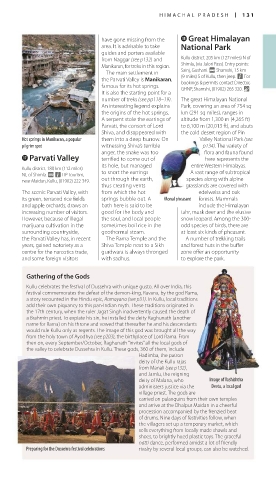
Hot springs in Manikaran, a popular them into a deep burrow. On Valley National Park (see
pilgrim spot witnessing Shiva’s terrible p134). The variety of
anger, the snake was too flora and fauna found
u Parvati Valley terrified to come out of here represents the
its hole, but managed entire Western Himalayas.
Kullu district. 180 km (112 miles)
NE of Shimla. @ n HP Tourism, to snort the earrings A vast range of subtropical
near Maidan, Kullu, (01902) 222 349. out through the earth, species along with alpine
thus creating vents grasslands are covered with
The scenic Parvati Valley, with from which the hot edelweiss and oak
its green, terraced rice fields springs bubble out. A Monal pheasant forests. Mammals
and apple orchards, draws an bath here is said to be include the Himalayan
increasing number of visitors. good for the body and tahr, musk deer and the elusive
However, because of illegal the soul, and local people snow leopard. Among the 300-
marijuana cultivation in the sometimes boil rice in the odd species of birds, there are
surrounding countryside, geothermal steam. at least six kinds of pheasant.
the Parvati Valley has, in recent The Rama Temple and the A number of trekking trails
years, gained notoriety as a Shiva Temple next to a Sikh and forest huts in the buffer
centre for the narcotics trade, gurdwara is always thronged zone offer an opportunity
and some foreign visitors with sadhus. to explore the park.
Gathering of the Gods
Kullu celebrates the festival of Dussehra with unique gusto. All over India, this
festival commemorates the defeat of the demon-king, Ravana, by the god Rama,
a story recounted in the Hindu epic, Ramayana (see p31). In Kullu, local traditions
add their own piquancy to this pan-Indian myth. These traditions originated in
the 17th century, when the ruler Jagat Singh inadvertently caused the death of
a Brahmin priest. To expiate his sin, he installed the deity Raghunath (another
name for Rama) on his throne and vowed that thereafter he and his descendants
would rule Kullu only as regents. The image of this god was brought all the way
from the holy town of Ayodhya (see p203), the birthplace of Lord Rama. From
then on, every September/October, Raghunath “invites” all the local gods of
the valley to celebrate Dussehra in Kullu. These gods, 360 of them, include
Hadimba, the patron
deity of the Kullu rajas
from Manali (see p132),
and Jamlu, the reigning
deity of Malana, who Image of Vashishtha
administers justice via the Devta, a local god
village priest. The gods are
carried on palanquins from their own temples
and arrive at the Dhalpur Maidan in a cheerful
procession accompanied by the frenzied beat
of drums. Nine days of festivities follow, when
the villagers set up a temporary market, which
sells everything from locally made shawls and
shoes, to brightly hued plastic toys. The graceful
natti dance, performed amidst a lot of friendly
Preparing for the Dussehra festival celebrations rivalry by several local groups, can also be watched.
130-131_EW_India.indd 131 26/04/17 11:43 am

