


Page 24 - (DK Eyewitness) Travel Guide: Japan
P. 24
22 INTRODUCING JAP AN
in the annual cycle of
matsuri (festivals).
Wherever one looks,
a stimulating fusion of
East and West reveals
itself: Zen priests on
Hondas; the salaryman
bowing deeply to a
client on his cell phone;
neon signs written in
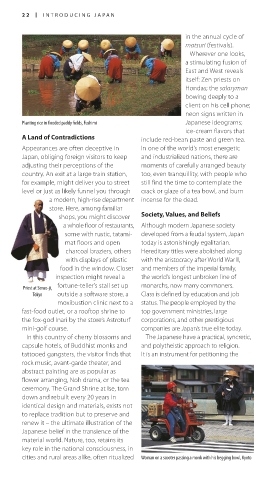
Planting rice in flooded paddy fields, Fushimi Japanese ideograms;
ice-cream flavors that
A Land of Contradictions include red-bean paste and green tea.
Appearances are often deceptive in In one of the world’s most energetic
Japan, obliging foreign visitors to keep and indus trialized nations, there are
adjusting their perceptions of the moments of carefully arranged beauty
country. An exit at a large train station, too, even tranquillity, with people who
for example, might deliver you to street still find the time to contemplate the
level or just as likely funnel you through crack or glaze of a tea bowl, and burn
a modern, high-rise department incense for the dead.
store. Here, among familiar
shops, you might discover Society, Values, and Beliefs
a whole floor of restaurants, Although modern Japanese society
some with rustic, tatami- developed from a feudal system, Japan
mat floors and open today is astonishingly egalitarian.
charcoal braziers, others Hereditary titles were abolished along
with dis plays of plastic with the aristo cracy after World War II,
food in the window. Closer and members of the imperial family,
inspection might reveal a the world’s longest unbroken line of
Priest at Senso-ji, fortune-teller’s stall set up monarchs, now marry commoners.
Tokyo outside a software store, a Class is defined by education and job
moxibustion clinic next to a status. The people employed by the
fast-food outlet, or a rooftop shrine to top government ministries, large
the fox-god Inari by the store’s Astroturf corporations, and other prestigious
mini-golf course. compa nies are Japan’s true elite today.
In this country of cherry blossoms and The Japanese have a practical, syn cretic,
capsule hotels, of Buddhist monks and and polytheistic approach to religion.
tattooed gangsters, the visitor finds that It is an instrument for petitioning the
rock music, avant-garde theater, and
abstract painting are as popular as
flower arranging, Noh drama, or the tea
cere mony. The Grand Shrine at Ise, torn
down and rebuilt every 20 years in
identical design and materials, exists not
to replace tradition but to preserve and
renew it – the ultimate illustration of the
Japanese belief in the transience of the
ma terial world. Nature, too, retains its
key role in the national consciousness, in
cities and rural areas alike, often ritualized Woman on a scooter passing a monk with his begging bowl, Kyoto
020-025_EW_Japan.indd 22 08/08/16 4:02 pm

