


Page 26 - (DK Eyewitness) Travel Guide: Japan
P. 26
24 INTRODUCING JAP AN
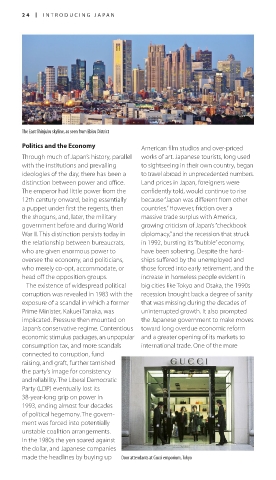
The East Shinjuku skyline, as seen from Ebisu District
Politics and the Economy American film studios and over-priced
Through much of Japan’s history, parallel works of art. Japanese tourists, long used
with the institutions and prevailing to sight seeing in their own country, began
ideologies of the day, there has been a to travel abroad in unprecedented numbers.
distinction between power and office. Land prices in Japan, foreigners were
The emperor had little power from the confidently told, would continue to rise
12th century onward, being essentially because “Japan was different from other
a puppet under first the regents, then countries.” However, friction over a
the shoguns, and, later, the military massive trade surplus with America,
government before and during World growing criticism of Japan’s “checkbook
War II. This distinction persists today in diplomacy,” and the recession that struck
the relationship between bureaucrats, in 1992, bursting its “bubble” economy,
who are given enormous power to have been sobering. Despite the hard-
oversee the economy, and politicians, ships suffered by the unemployed and
who merely co-opt, accommodate, or those forced into early retirement, and the
head off the opposition groups. increase in homeless people evident in
The existence of widespread political big cities like Tokyo and Osaka, the 1990s
corruption was revealed in 1983 with the recession brought back a degree of sanity
exposure of a scandal in which a former that was missing during the decades of
Prime Minister, Kakuei Tanaka, was unin terrupted growth. It also prompted
implicated. Pressure then mounted on the Japanese government to make moves
Japan’s conservative regime. Contentious toward long overdue economic reform
economic stimulus packages, an unpopular and a greater opening of its markets to
consumption tax, and more scandals inter national trade. One of the more
connected to corruption, fund
raising, and graft, further tarnished
the party’s image for consistency
and reliability. The Liberal Democratic
Party (LDP) eventually lost its
38-year-long grip on power in
1993, ending almost four decades
of political hegemony. The govern-
ment was forced into potentially
unstable coalition arrangements.
In the 1980s the yen soared against
the dollar, and Japanese companies
made the headlines by buying up Door attendants at Gucci emporium, Tokyo
020-025_EW_Japan.indd 24 08/08/16 2:53 pm

