


Page 29 - (DK Eyewitness) Travel Guide: Japan
P. 29
A POR TR AIT OF JAP AN 27
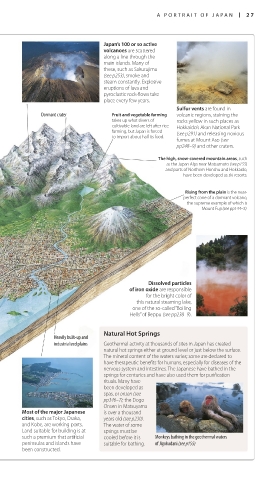
Japan’s 100 or so active
volcanoes are scattered
along a line through the
main is lands. Many of
these, such as Sakurajima
(see p253), smoke and
steam constantly. Explosive
eruptions of lava and
pyroclas tic rock-flows take
place every few years.
Sulfur vents are found in
Dormant crater Fruit and vegetable farming volcanic regions, staining the
takes up what slivers of rocks yellow in such places as
cultivable land are left after rice Hokkaido’s Akan National Park
farming, but Japan is forced (see p291) and releasing noxious
to import about half its food.
fumes at Mount Aso (see
pp248–9) and other craters.
The high, snow-covered mountain areas, such
as the Japan Alps near Matsumoto (see p155)
and parts of Northern Honshu and Hokkaido,
have been developed as ski resorts.
Rising from the plain is the near-
perfect cone of a dormant volcano,
the supreme example of which is
Mount Fuji (see pp144–5).
Dissolved particles
of iron oxide are responsible
for the bright color of
this natural steaming lake,
one of the so-called “Boiling
Hells” of Beppu (see pp238–9).
Natural Hot Springs
Heavily built-up and
industrialized plains Geothermal activity at thousands of sites in Japan has created
natural hot springs either at ground level or just below the surface.
The mineral content of the waters varies; some are declared to
have therapeutic benefits for humans, especially for diseases of the
nervous system and intestines. The Japanese have bathed in the
springs for centuries and have also used them for purification
rituals. Many have
been developed as
spas, or onsen (see
pp346–7); the Dogo
Onsen in Matsuyama
Most of the major Japanese is over a thousand
cities, such as Tokyo, Osaka, years old (see p230).
and Kobe, are working ports. The water of some
Land suitable for building is at springs must be
such a premium that artificial cooled before it is Monkeys bathing in the geothermal waters
peninsulas and islands have suitable for bathing. of Jigokudani (see p155)
been constructed.
026-027_EW_Japan.indd 27 08/08/16 2:53 pm

