


Page 25 - (DK Eyewitness) Travel Guide: Japan
P. 25
A POR TR AIT OF JAP AN 23
increasing appeal. Young couples now
prefer to live apart from their parents,
and men are gradually reducing after-
hours socializing, in order to spend
more time with their family. The
steady increase in the divorce rate
and the larger number of women
who remain unmarried are other indica-
tions of changes taking place. The latter
is often a decision on the part of
Japanese women who cannot find
partners with the right credentials.
Thus, what might appear to be a
contemporary Western-driven
ten dency, or an expression of femi nist
awareness, is a reflection, to some
degree, of orthodoxy.
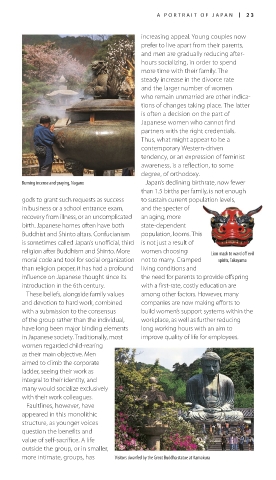
Burning incense and praying, Nagano Japan’s declining birthrate, now fewer
than 1.5 births per family, is not enough
gods to grant such requests as success to sustain current population levels,
in business or a school entrance exam, and the specter of
recovery from illness, or an uncomplicated an aging, more
birth. Japanese homes often have both state-dependent
Buddhist and Shinto altars. Confucianism population, looms. This
is sometimes called Japan’s unofficial, third is not just a result of
religion after Buddhism and Shinto. More women choosing Lion mask to ward off evil
moral code and tool for social organization not to marry. Cramped spirits, Takayama
than religion proper, it has had a profound living conditions and
influence on Japanese thought since its the need for parents to provide offspring
introduction in the 6th century. with a first-rate, costly education are
These beliefs, alongside family values among other factors. However, many
and devotion to hard work, combined companies are now making efforts to
with a submission to the consensus build women’s support systems within the
of the group rather than the individual, workplace, as well as further reducing
have long been major binding elements long working hours with an aim to
in Japanese society. Traditionally, most improve quality of life for employees.
women regarded child-rearing
as their main objective. Men
aimed to climb the corporate
ladder, see ing their work as
integral to their identity, and
many would socialize exclusively
with their work colleagues.
Faultlines, however, have
appeared in this monolithic
structure, as younger voices
question the benefits and
value of self-sacrifice. A life
outside the group, or in smaller,
more intimate, groups, has Visitors dwarfed by the Great Buddha statue at Kamakura
020-025_EW_Japan.indd 23 08/08/16 2:53 pm

