


Page 28 - (DK Eyewitness) Travel Guide: Japan
P. 28
26 INTRODUCING JAP AN
The Landscape of Japan
North
American
Japan lies on the intersection of four plates and is the Plate
world’s most geologically active zone. The islands themselves
were pushed up from the ocean floor by earth movements.
Evidence of this activity can be seen in the sharply defined
mountain ranges rising from the plains, in smoking Eurasian
Plate
volcanoes, and in hot mineral waters that well up from the Pacific
ground. The Japanese take earth quakes, volcanoes, tsunamis, Plate
and typhoons in their stride, building and rebuilding their
towns wherever they can find flat land. Modern cityscapes
(see pp28–9) contrast greatly with the seasonal beauty of Philippine
Plate
the rela tively undeveloped mountainous interior, and the
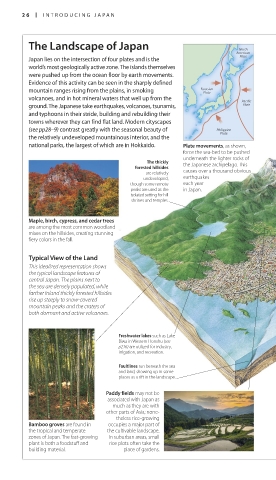
national parks, the largest of which are in Hokkaido. Plate movements, as shown,
force the seabed to be pushed
underneath the lighter rocks of
The thickly the Japanese archipelago. This
forested hillsides
are relatively causes over a thousand obvious
undeveloped, earthquakes
though some remote each year
peaks are used as the in Japan.
iso lated setting for hill
shrines and temples.
Maple, birch, cypress, and cedar trees
are among the most common woodland
mixes on the hillsides, creating stunning
fiery colors in the fall.
Typical View of the Land
This idealized representation shows
the typical landscape features of
central Japan. The plains next to
the sea are densely populated, while
farther inland thickly forested hillsides
rise up steeply to snow-covered
mountain peaks and the craters of
both dormant and active volcanoes.
Freshwater lakes such as Lake
Biwa in Western Honshu (see
p216) are utilized for industry,
irrigation, and recreation.
Faultlines run beneath the sea
and land, showing up in some
places as a rift in the landscape.
Paddy fields may not be
associated with Japan as
much as they are with
other parts of Asia; none
theless ricegrowing
Bamboo groves are found in occupies a major part of
the tropical and temperate the cultivable landscape.
zones of Japan. The fastgrowing In suburban areas, small
plant is both a food stuff and rice plots often take the
building material. place of gardens.
026-027_EW_Japan.indd 26 08/08/16 2:53 pm

