


Page 278 - (DK Eyewitness) Travel Guide: Japan
P. 278
276 JAP AN REGION B Y REGION
3 Mashiko
Mashiko
Tochigi prefecture. * 23,600.
£ (local trains only). @ from Tobu-
Utsunomiya stn. n next to Mashiko
stn (0285-70-1120). _ Pottery
Festivals (end Apr to early May;
end Oct to early Nov).
Known for its folk pottery,
Mashiko was home to the
world-famous potter Shoji
Hamada (1894–1978), a founder
of the mingei (folk art) move-
ment. A long stretch of a town,
Mashiko has hundreds of
pottery shops and workshops.
Bicycles are easy to rent and
are the best way to explore.
The excellent Mashiko
Sankokan Museum contains
Hamada’s studio and kiln,
and his eclectic collection
of ceramics and other crafts,
housed in beautifully restored
local buildings. Moegi and Toko
galleries, on the main street,
showcase local potters. On the
corner, by Toko, is the eighth-
generation Higeta Dyeworks
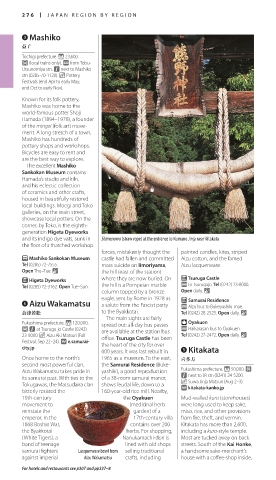
and its indigo dye vats, sunk in Shimenawa (straw rope) at the entrance to Kumano Jinja near Kitakata
the floor of a thatched workshop.
forces, mistakenly thought the painted candles, kites, striped
P Mashiko Sankokan Museum castle had fallen and committed Aizu cotton, and the famed
Tel (0285) 72-7555. mass suicide on Iimoriyama, Aizu lacquerware.
Open Thu–Tue. & the hill (east of the station)
E Higeta Dyeworks where they are now buried. On E Tsuruga Castle
Tel (0285) 72-3162. Open Tue–Sun. the hill is a Pompeian marble @ to Tsurugajo. Tel (0242) 23-8000.
column topped by a bronze Open daily. &
eagle, sent by Rome in 1928 as E Samurai Residence
4 Aizu Wakamatsu a salute from the Fascist party @ Aizu bus to Bukeyashiki-mae.
Aizu Wakamatsu Tel (0242) 28-2525. Open daily. &
to the Byakkotai.
The main sights are fairly
Fukushima prefecture. * 120,000. spread out: all-day bus passes Y Oyakuen
£ n at Tsuruga-jo Castle (0242) are available at the station bus @ Haikarasan bus to Oyakuen.
23-8000. _ Aizu Aki Matsuri (Fall office. Tsuruga Castle has been Tel (0242) 27-2472. Open daily. &
Festival, Sep 22–24). ∑ e.samurai- the heart of the city for over
city.jp 5 Kitakata
600 years. It was last rebuilt in
Once home to the north’s 1965 as a museum. To the east, Kitakata
second most powerful clan, the Samurai Residence (Buke-
Aizu Wakamatsu takes pride in yashiki), a good reproduction Fukushima prefecture. * 50,000. £
n next to JR stn (0241) 24-5200.
its samurai past. With ties to the of a 38-room samurai manor, _ Suwa Jinja Matsuri (Aug 2–3).
Tokugawas, the Matsudaira clan shows feudal life, down to a ∑ kitakata-kanko.jp
bitterly resist ed the 160-year-old rice mill. Nearby,
19th-century the Oyakuen Mud-walled kura (storehouses)
movement to (medicinal herb were long used to keep sake,
reinstate the garden) of a miso, rice, and other provisions
emperor. In the 17th-century villa from fire, theft, and vermin.
1868 Boshin War, contains over 200 Kitakata has more than 2,600,
the Byak kotai herbs. For shopping, including a kura-style temple.
(White Tigers), a Nanukamachi-dori is Most are tucked away on back
band of teenage lined with old shops streets. South of the Kai Honke,
samurai fighters Lacquerware bowl from selling traditional a hand some sake-merchant’s
against imperial Aizu Wakamatsu crafts, including house with a coffee-shop inside,
For hotels and restaurants see p307 and pp337–8
276-277_EW_Japan.indd 276 08/08/16 3:09 pm
Eyewitness Travel LAYERS PRINTED:
Catalogue template “UK” LAYER
(Source v2.6)
Date 12th July 2013
Size 125mm x 217mm

