


Page 318 - (DK Eyewitness) Travel Guide: Japan
P. 318
316 TR A VELERS ’ NEEDS
The Flavors of Japan
More so than in most developed countries, where the produce
of the entire world is available in supermarkets all year round,
Japan is a country in which local and seasonal produce is still
highly valued. The Japanese often use a region’s speciality
as a reason for travel, going out of their way to find a
restaurant famed for local cuisine. The food cultures of Tokyo
and the Kansai region were in competition for hundreds
of years. The eventual dominance of Tokyo’s Edo cuisine
mirrors the historical trend whereby Kyoto and the Kansai
region have gradually lost their cultural supremacy. Ramen noodles
from diverse parts of the as one of the true tastes of Edo
country, that is today the cuisine. As more people from
most commonly recognized the north of Japan moved to
form of Japanese food. Edo, udon noodles, which were
The story of the ascendancy popular in the south, were
of Edo cuisine is also that of replaced by soba noodles.
the decline in dominance of Soba is most commonly eaten
typical Kansai flavors. Soba has in the same simple way that it
been a popular food among was eaten all that time ago: in
Edo residents since the late a zaru (a small bamboo sieve).
17th century and is renowned The weaker soy sauce of the
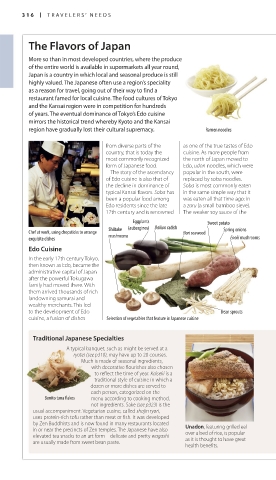
Eggplants Sweet potato
Shiitake (aubergines) Daikon radish Spring onions
Chef at work, using chopsticks to arrange mushrooms Nori seaweed
exquisite dishes Enoki mushrooms
Edo Cuisine
In the early 17th century Tokyo,
then known as Edo, became the
administrative capital of Japan
after the powerful Tokugawa
family had moved there. With
them arrived thousands of rich
landowning samurai and
wealthy merchants. This led
to the development of Edo Bean sprouts
cuisine, a fusion of dishes Selection of vegetables that feature in Japanese cuisine
Traditional Japanese Specialties
A typical banquet, such as might be served at a
ryotei (see p310), may have up to 20 courses.
Much is made of seasonal ingredients,
with decorative flourishes also chosen
to reflect the time of year. Kaiseki is a
traditional style of cuisine in which a
dozen or more dishes are served to
each person, categorized on the
Bonito tuna flakes menu according to cooking method,
not ingredients. Sake (see p323) is the
usual accompaniment. Vegetarian cusine, called shojin ryori,
uses protein-rich tofu rather than meat or fish. It was developed
by Zen Buddhists and is now found in many restaurants located Unadon, featuring grilled eel Tempura, originally a
in or near the precincts of Zen temples. The Japanese have also over a bed of rice, is popular Portuguese dish, is lightly
elevated tea snacks to an art form – delicate and pretty wagashi as it is thought to have great battered deep-fried vegetables
are usually made from sweet bean paste.
health benefits. or fish.
316-317_EW_Japan.indd 316 08/08/16 3:09 pm
Eyewitness Travel LAYERS PRINTED:
Feature template “UK” LAYER
(SourceReport v1.3)
Date 7th January 2013
Size 125mm x 217mm

