


Page 313 - (DK Eyewitness) Travel Guide: Japan
P. 313
WHERE T O EA T AND DRINK 311
that serve such things as ebi-furai
(fried shrimp) and korokke
(croquettes). These items became
very popular among Japanese
during the Meiji and Taisho per-
iods. The Japanese still think of
these dishes as Western al though
outside of Japan they would
hardly be recognized as such.
Rice is served on a plate, not in
a bowl, and eaten with a fork.
Famiri resutoran (family
restaurants) are American-style
chains (Royal Host is a typical
example), whose extensive
picture menus, late hours, and
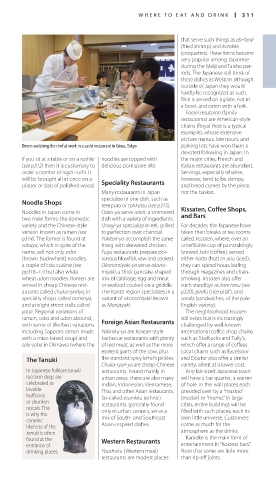
Diners watching the chef at work in a sushi restaurant in Ginza, Tokyo parking lots have won them a
devoted following in Japan. In
If you sit at a table or on a zashiki noodles are topped with the major cities, French and
(see p312) then it is customary to delicious pork spare rib). Italian restaurants are abundant.
order a combo of nigiri-zushi. It Servings, especially of wine,
will be brought all at once on a Speciality Restaurants however, tend to be skimpy,
platter or slab of polished wood. and bread comes by the piece,
Many restaurants in Japan not the basket.
specialize in one dish, such as
Noodle Shops
tempura or tonkatsu (see p315).
Noodles in Japan come in Oden -ya serve oden, a simmered Kissaten, Coffee Shops,
two main forms: the domestic dish with a variety of ingredients. and Bars
variety and the Chinese-style Unagi-ya specialize in eel, grilled For decades the Japanese have
version known as ramen (see to perfection over charcoal. taken their breaks at tea rooms
p314). The former is found at Yakitori -ya accomplish the same called kissaten, where, over an
sobaya, which in spite of the thing with skewered chicken. unrefillable cup of painstakingly
name, sell not only soba Fugu restaurants prepare poi- brewed kohi (coffee), served
(brown buckwheat) noodles, sonous blow fish, raw and cooked. either hotto (hot) or aisu (iced),
a staple of Edo cuisine (see Okonomiyaki-ya serve okono- they can spend hours leafing
pp316–17) but also white miyaki, a thick pancake-shaped through magazines and chain-
wheat udon noodles. Ramen are mix of cabbage, egg and meat smoking. Kissaten also offer
served in cheap Chinese rest- or seafood cooked on a griddle. such standbys as kare raisu (see
aurants called chuka-ryoriya, in The Kantō region special izes in a p320), pirafu (rice pilaf), and
specialty shops called ramenya, variant of okonomiyaki known sando (sandwiches, of the pale
and at night street stalls called as Monjayaki. English variety).
yatai. Regional variations of The neighborhood kissaten
ramen, soba and udon abound, still exists but is increasingly
with some of the best variations Foreign Asian Restaurants challenged by well-known
including Sapporo ramen made Yakiniku-ya are Korean-style international coffee shop chains
with a miso-based soup) and barbecue restaurants with plenty such as Starbucks and Tully’s,
soki-soba in Okinawa (where the of red meat, as well as the more which offer a range of coffees.
esoteric parts of the cow, plus Local chains such as Excelssior
The Tanuki the standard spicy kimchi pickles. and Doutor also offer a similar
Chuka-ryori-ya are cheap Chinese variety, albeit at a lower cost.
In Japanese folklore tanuki restaurants. Found mainly in Any fair-sized Japanese town
raccoon dogs are urban areas, there are also many will have a bar quarter, a warren
celebrated as Indian, Indonesian, Vietnamese, of hole-in-the-wall places each
lovable Thai, and other Asian restaurants. presided over by a “mastaa”
buffoons So-called esunikku (ethnic) (master) or “mama.” In large
or drunken restaurants, generally found cities, entire buildings will be
rascals. This only in urban centers, serve a filled with such places, each its
is why the
ceramic mix of South- and Southeast own little universe. Customers
likeness of the Asian-inspired dishes. come as much for the
tanuki is often atmosphere as the drinks.
found at the Western Restaurants Karaoke is the main form of
entrance of entertainment in “hostess bars.”
drinking places. Youshoku (Western meal) Note that some are little more
restaurants are modest places than rip-off joints.
310-311_EW_Japan.indd 311 08/08/16 3:09 pm

