


Page 49 - (DK Eyewitness) Travel Guide: Japan
P. 49
A POR TR AIT OF JAP AN 47
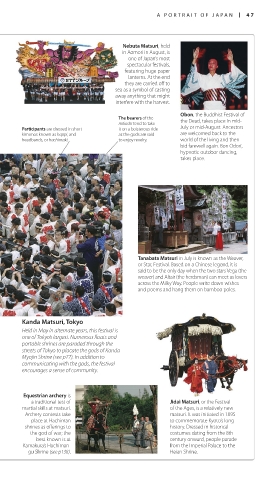
Nebuta Matsuri, held
in Aomori in August, is
one of Japan’s most
spec tacular festivals,
featuring huge paper
lanterns. At the end
they are carried off to
sea as a symbol of casting
away anything that might
interfere with the harvest.
Obon, the Buddhist Festival of
The bearers of the
mikoshi tend to take the Dead, takes place in mid-
Participants are dressed in short it on a boisterous ride July or mid-August. Ancestors
kimonos known as happi, and as the gods are said are welcomed back to the
headbands, or hachimaki. to enjoy revelry. world of the living and then
bid fare well again. Bon Odori,
hypnotic outdoor dancing,
takes place.
Tanabata Matsuri in July is known as the Weaver,
or Star, Festival. Based on a Chinese legend, it is
said to be the only day when the two stars Vega (the
weaver) and Altair (the herdsman) can meet as lovers
across the Milky Way. People write down wishes
and poems and hang them on bamboo poles.
Kanda Matsuri, Tokyo
Held in May in alternate years, this festival is
one of Tokyo’s largest. Numerous floats and
portable shrines are paraded through the
streets of Tokyo to placate the gods of Kanda
Myojin Shrine (see p77). In addition to
communicating with the gods, the festival
encourages a sense of community.
Equestrian archery is
a traditional test of Jidai Matsuri, or the Festival
martial skills at matsuri. of the Ages, is a relatively new
Archery contests take matsuri. It was initiated in 1895
place at Hachiman to commemorate Kyoto’s long
shrines as offerings to history. Dressed in historical
the god of war; the costumes dating from the 8th
best known is at century onward, people parade
Kama kura’s Hachiman- from the Imperial Palace to the
gu Shrine (see p138). Heian Shrine.
046-047_EW_Japan.indd 47 08/08/16 2:53 pm

