


Page 45 - (DK Eyewitness) Travel Guide: Japan
P. 45
A POR TR AIT OF JAP AN 43
Textiles
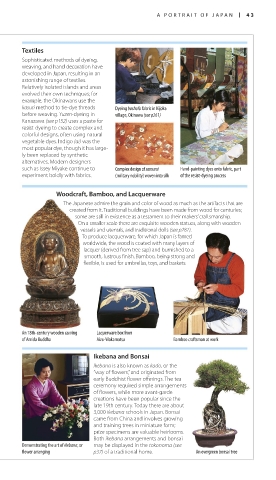
Sophisticated methods of dyeing,
weaving, and hand decoration have
developed in Japan, resulting in an
astonish ing range of textiles.
Relatively isolated islands and areas
evolved their own techniques; for
example, the Okinawans use the
kasuri method to tie-dye threads Dyeing bashofu fabric in Kijoka
before weaving. Yuzen-dyeing in village, Okinawa (see p261)
Kanazawa (see p152) uses a paste for
resist-dyeing to create complex and
colorful designs, often using natural
vegetable dyes. Indigo (ai) was the
most popular dye, though it has large-
ly been replaced by synthetic
alternatives. Modern designers
such as Issey Miyake continue to Complex design of samurai Hand-painting dyes onto fabric, part
experiment boldly with fabrics. (military nobility) woven into silk of the resist-dyeing process
Woodcraft, Bamboo, and Lacquerware
The Japanese admire the grain and color of wood as much as the artifacts that are
created from it. Traditional buildings have been made from wood for centuries;
some are still in existence as a testament to their makers’ craftsmanship.
On a smaller scale there are exquisite wooden statues, along with wooden
vessels and utensils, and traditional dolls (see p281).
To produce lacquerware, for which Japan is famed
worldwide, the wood is coated with many layers of
lacquer (derived from tree sap) and burnished to a
smooth, lustrous finish. Bamboo, being strong and
flexible, is used for umbrellas, toys, and baskets.
An 18th-century wooden carving Laquerware box from
of Amida Buddha Aizu-Wakamatsu Bamboo craftsman at work
Ikebana and Bonsai
Ikebana is also known as kado, or the
“way of flowers,” and originated from
early Buddhist flower offerings. The tea
ceremony required simple arrangements
of flowers, while more avant-garde
creations have been popular since the
late 19th century. Today there are about
3,000 ikebana schools in Japan. Bonsai
came from China and involves growing
and training trees in miniature form;
prize specimens are valuable heirlooms.
Both ikebana arrangements and bonsai
Demonstrating the art of ikebana, or may be displayed in the toko noma (see
flower arranging p37) of a traditional home. An evergreen bonsai tree
042-043_EW_Japan.indd 43 08/08/16 3:05 pm

