


Page 46 - (DK Eyewitness) Travel Guide: Japan
P. 46
44 INTRODUCING JAP AN
Japanese Traditional Dress
Although most Japanese now wear Western-style clothes
(yofuku), it is not unusual to glimpse a kimono-clad woman
in the street or a man relaxing in a lightweight summer
kimono (yukata). Kimonos are wraparound garments worn
by men and women, usually on formal occasions and at
festivals. Some people change into a cotton kimono to relax Kimono style for women and
men has changed little since
in the evenings. A good kimono can last for years, even the Edo period.
gener ations – it is made to a standard pattern, rather than
to fit the wearer; the fitting is done when dressing. The left
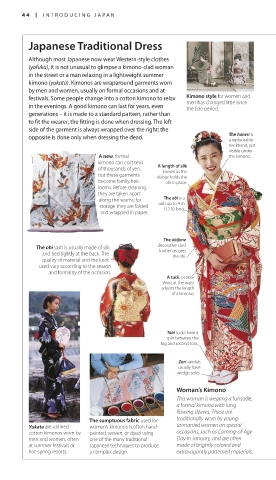
side of the garment is always wrapped over the right; the The haneri is
opposite is done only when dressing the dead. a replaceable
neckband, just
visible under
A new, formal the kimono.
kimono can cost tens
of thousands of yen, A length of silk
known as the
but these garments obiage holds the
become family heir- obi in place.
looms. Before clean ing,
they are taken apart
along the seams; for The obi is a
storage they are folded sash up to 4 m
(13 ft) long.
and wrapped in paper.
The obijime
The obi sash is usually made of silk decorative cord
further secures
and tied tightly at the back. The the obi.
quality of material and the knot
used vary according to the season
and formality of the occasion.
A tuck, or oha-
shiori, at the waist
adjusts the length
of a kimono.
Tabi socks have a
split between the
big and second toes.
Zori sandals
usually have
wedge soles.
Woman’s Kimono
This woman is wearing a furisode,
a formal kimono with long,
flowing sleeves. These are
The sumptuous fabric used for traditionally worn by young,
Yukata are unlined women’s kimonos is often hand- unmarried women on special
cotton kimonos worn by painted, woven, or dyed using occasions, such as Coming-of-Age
men and women, often one of the many traditional Day in Janu ary, and are often
at summer festivals or Japanese techniques to produce made of brightly colored and
hot-spring resorts. a complex design. extrava gantly patterned materials.
044-045_EW_Japan.indd 44 08/08/16 3:05 pm
Eyewitness Travel LAYERS PRINTED:
Feature template “UK” LAYER
(SourceReport v1.3)
Date 18th October 2012
Size 125mm x 217mm

