


Page 44 - (DK Eyewitness) Travel Guide: Japan
P. 44
42 INTRODUCING JAP AN
Traditional Arts and Crafts
In Japan there is no rigid distinction between arts and crafts;
both have a long, distin guished history and are equally prized.
Many techniques came to Japan from the Asian continent,
especially China and Korea, and have since evolved and been
refined. Early arts and crafts were dominated by Buddhist
influences, but from medieval times onward they became Metalwork includes items
increasingly secular and decora tive. Traditional arts and crafts such as samurai swords,
temple bells, and tea
still thrive, with thousands of practitioners making a living from kettles. This tea kettle is
their work. Artisans can be seen at work in many areas. from Morioka (see p281).
Calligraphy
Known as shodo, the way of writing, the art of calligraphy was intro
duced to Japan along with the Chinese writing system in the 5th
century and came to be considered as an essential accomplishment
for the cultured person. Tradi tional writing implements consist of a
brush, ink, an inkstone, and a
water vessel. Buddhist monks
have often led the development
of styles through the centuries.
Modern calligraphy has been
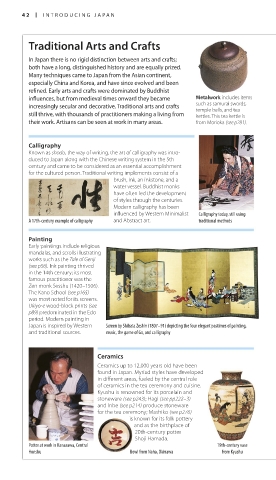
influenced by Western Minimalist Calligraphy today, still using
A 17th-century example of calligraphy and Abstract art. traditional methods
Painting
Early paintings include reli gious
mandalas, and scrolls illustrating
works such as the Tale of Genji
(see p56). Ink painting thrived
in the 14th century; its most
famous prac titioner was the
Zen monk Sesshu (1420–1506).
The Kano School (see p165)
was most noted for its screens.
Ukiyo-e woodblock prints (see
p89) predominated in the Edo
period. Modern painting in
Japan is inspired by Western Screen by Shibata Zeshin (1807–91) depicting the four elegant pastimes of painting,
and traditional sources. music, the game of Go, and calligraphy
Ceramics
Ceramics up to 12,000 years old have been
found in Japan. Myriad styles have developed
in differ ent areas, fueled by the central role
of ceramics in the tea ceremony and cuisine.
Kyushu is renowned for its porcelain and
stoneware (see p243); Hagi (see pp222–3)
and Inbe (see p214) produce stoneware
for the tea ceremony; Mashi ko (see p276)
is known for its folk pottery
and as the birthplace of
20thcentury potter
Shoji Hamada.
Potter at work in Kanazawa, Central 19th-century vase
Honshu Bowl from Naha, Okinawa from Kyushu
042-043_EW_Japan.indd 42 08/08/16 3:05 pm
Eyewitness Travel LAYERS PRINTED:
Feature template “UK” LAYER
(SourceReport v1.3)
Date 18th October 2012
Size 125mm x 217mm

