


Page 47 - (DK Eyewitness) Travel Guide: Japan
P. 47
A POR TR AIT OF JAP AN 45
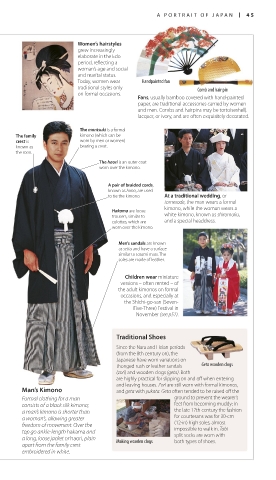
Women’s hairstyles
grew increasingly
elaborate in the Edo
period, reflecting a
woman’s age and social
and marital status.
Today, wo men wear Handpainted fan
traditional styles only Comb and hair pin
on formal occasions.
Fans, usually bamboo covered with hand-painted
paper, are traditional accessories carried by women
and men. Combs and hairpins may be tortoiseshell,
lacquer, or ivory, and are often exquisitely decorated.
The montsuki is a formal
The family kimono (which can be
crest is worn by men or women)
known as bearing a crest.
the mon.
The haori is an outer coat
worn over the kimono.
A pair of braided cords,
known as himo, are used
to tie the kimono. At a traditional wedding, or
tomesode, the man wears a formal
kimono, while the woman wears a
Hakama are loose
trousers, similar to white kimono, known as shiromuku,
culottes, which are and a special headdress.
worn over the kimono.
Men’s sandals are known
as setta and have a surface
similar to tatami mats. The
soles are made of leather.
Children wear miniature
versions – often rented – of
the adult kimonos on formal
occasions, and especially at
the Shichi-go-san (Seven-
Five-Three) Festival in
November (see p51).
Traditional Shoes
Since the Nara and Heian periods
(from the 8th century on), the
Japanese have worn variations on
thonged rush or leather sandals Geta wooden clogs
(zori) and wooden clogs (geta). Both
are highly practical for slipping on and off when entering
and leaving houses. Zori are still worn with formal kimonos,
Man’s Kimono and geta with yukata. Geta often tended to be raised off the
Formal clothing for a man ground to prevent the wearer’s
consists of a black silk kimono; feet from becoming muddy; in
a man’s kimono is shorter than the late 17th century the fashion
a woman’s, allowing greater for courtesans was for 30-cm
freedom of movement. Over the (12-in) high soles, almost
top go ankle-length hakama and impossible to walk in. Tabi
split socks are worn with
a long, loose jacket or haori, plain Making wooden clogs both types of shoes.
apart from the family crest
embroidered in white.
044-045_EW_Japan.indd 45 08/08/16 3:05 pm

