


Page 48 - (DK Eyewitness) Travel Guide: Japan
P. 48
46 INTRODUCING JAP AN
Japan’s Festivals: Matsuri
Matsuri means both festival and worship, indicating the
Shinto origins of Japanese festivals. Some are nationwide,
others are local to individual temples and shrines. Matsuri
are a link between the human and the divine, often marking
stages in the rice-growing cycle (mainly planting and harvest)
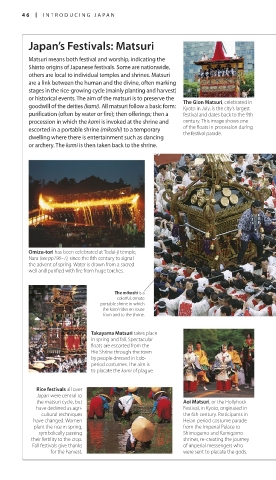
or historical events. The aim of the matsuri is to preserve the The Gion Matsuri, celebrated in
goodwill of the deities (kami). All matsuri follow a basic form: Kyoto in July, is the city’s largest
purifica tion (often by water or fire); then offerings; then a festival and dates back to the 9th
pro cession in which the kami is invoked at the shrine and century. This image shows one
escorted in a portable shrine (mikoshi) to a temporary of the floats in procession during
the festival parade.
dwelling where there is entertainment such as dancing
or archery. The kami is then taken back to the shrine.
Omizu-tori has been celebrated at Todai-ji temple,
Nara (see pp196–7), since the 8th century to signal
the advent of spring. Water is drawn from a sacred
well and purified with fire from huge torches.
The mikoshi is a
colorful, ornate
portable shrine in which
the kami rides en route
from and to the shrine.
Takayama Matsuri takes place
in spring and fall. Spectacular
floats are escorted from the
Hie Shrine through the town
by people dressed in Edo-
period costumes. The aim is
to placate the kami of plague.
Rice festivals all over
Japan were central to
the matsuri cycle, but Aoi Matsuri, or the Hollyhock
have declined as agri- Festival, in Kyoto, originated in
cultural techniques the 6th century. Participants in
have changed. Women Heian-period costume parade
plant the rice in spring, from the Imperial Palace to
symbolically passing Shimogamo and Kamigamo
their fertility to the crop. shrines, re-creating the journey
Fall festivals give thanks of imperial messengers who
for the harvest. were sent to placate the gods.
046-047_EW_Japan.indd 46 08/08/16 2:53 pm

