


Page 129 - (DK) The Business Book
P. 129
MAKING MONEY WORK          127

        See also: Accountability and governance 130–31   ■  Who bears the risk? 138–45    John Kay
        ■  Ignoring the herd 146–49   ■  Profit versus cash flow 152–53
                                                                            Professor John Kay is a British
                                                                            economist born in 1948. Best
                                                                            known for his sceptical support
                                                                            for free-market business
                                                                            behavior, he is a visiting
                                                                            professor at the London School
                                                                            of Economics and regular
                                                                            contributor to the Financial
                                                                            Times. In 2012 he presented
                                                                            a detailed report to the UK
                                                                            government on the stock
                                                                            market, which emphasized
                                                                            that the normal purpose
                                                                            of stock markets is not
                                                                            speculation, but to provide
                                                                            companies with access to
                                                                            capital and to provide savers
                                                                            with an opportunity to share
                                                                            in economic growth. He also
                                                                            highlighted concern about
                                                                            excess dividend payouts.
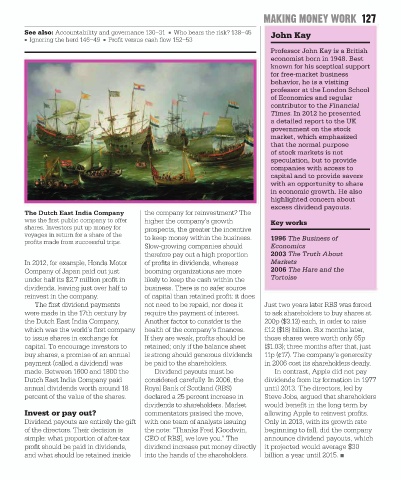
        The Dutch East India Company     the company for reinvestment? The
        was the first public company to offer   higher the company’s growth   Key works
        shares. Investors put up money for   prospects, the greater the incentive
        voyages in return for a share of the   to keep money within the business.   1996 The Business of
        profits made from successful trips.
                                         Slow-growing companies should      Economics
                                         therefore pay out a high proportion    2003 The Truth About
        In 2012, for example, Honda Motor   of profits in dividends, whereas   Markets
        Company of Japan paid out just   booming organizations are more     2006 The Hare and the
        under half its $2.7 million profit in   likely to keep the cash within the   Tortoise
        dividends, leaving just over half to   business. There is no safer source
        reinvest in the company.         of capital than retained profit: it does
           The first dividend payments    not need to be repaid, nor does it   Just two years later RBS was forced
        were made in the 17th century by   require the payment of interest.   to ask shareholders to buy shares at
        the Dutch East India Company,    Another factor to consider is the   200p ($3.13) each, in order to raise
        which was the world’s first company   health of the company’s finances.    £12 ($18) billion. Six months later,
        to issue shares in exchange for   If they are weak, profits should be   those shares were worth only 65p
        capital. To encourage investors to   retained; only if the balance sheet    ($1.03); three months after that, just
        buy shares, a promise of an annual   is strong should generous dividends   11p (¢17). The company’s generosity
        payment (called a dividend) was   be paid to the shareholders.    in 2006 cost its shareholders dearly.
        made. Between 1600 and 1800 the     Dividend payouts must be         In contrast, Apple did not pay
        Dutch East India Company paid    considered carefully. In 2006, the   dividends from its formation in 1977
        annual dividends worth around 18   Royal Bank of Scotland (RBS)   until 2013. The directors, led by
        percent of the value of the shares.  declared a 25 percent increase in   Steve Jobs, argued that shareholders
                                         dividends to shareholders. Market   would benefit in the long term by
        Invest or pay out?               commentators praised the move,   allowing Apple to reinvest profits.
        Dividend payouts are entirely the gift  with one team of analysts issuing   Only in 2013, with its growth rate
        of the directors. Their decision is   the note: “Thanks Fred [Goodwin,   beginning to fall, did the company
        simple: what proportion of after-tax   CEO of RBS], we love you.” The   announce dividend payouts, which
        profit should be paid in dividends,   dividend increase put money directly  it projected would average $30
        and what should be retained inside   into the hands of the shareholders.   billion a year until 2015. ■

