


Page 131 - (DK) The Business Book
P. 131
MAKING MONEY WORK          129

        See also: Managing risk 40–41   ■  Hubris and nemesis 100–03   ■  Investment and   Treasury in focus
        dividends 126–27   ■  Who bears the risk? 138–45   ■  Leverage and excess risk 150–51
                                                                            For the decade prior to the
                                                                            financial crisis of 2007–08,
                                         to rise, but in fact it underwent a
                                                                            many companies began to use
                                         sharp devaluation and the company
                                                                            short-term financing to fund
                                         ended up losing $2.5 billion.
                                                                            long-term capital expenditure.
                                         As a result, some companies now
                                                                            However, the financial crisis of
                                         spell out their opposition to making   2007–08 changed conditions
                                         money from money. Mining           dramatically, as banks
                                         multinational Rio Tinto, for example,   collapsed or came close to
                                         stated in its 2013 annual report that   doing so. CEOs demanded to
                                         its treasury “operates as a service   know where their company’s
                                         to the businesses of the Rio Tinto   cash was, and the real-time
                                         group and not as a profit center.”   cash position. Not all
                                                                            treasurers were able to
                                         Shadow banks                       provide immediate answers,
                                                                            since some of their
                                         Other companies, however, have
                                                                            investments were in local,
                                         extended the treasury function to
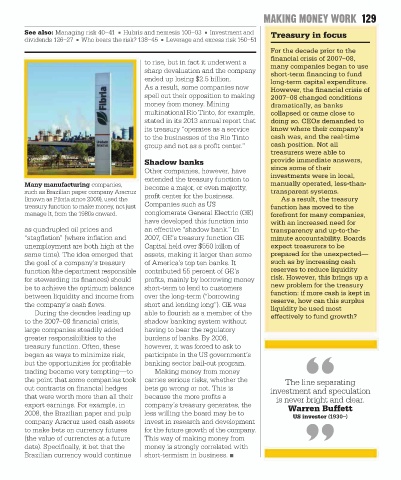
        Many manufacturing companies,    become a major, or even majority,   manually operated, less-than-
        such as Brazilian paper company Aracruz                             transparent systems.
        (known as Fibria since 2009), used the   profit center for the business.   As a result, the treasury
        treasury function to make money, not just   Companies such as US    function has moved to the
        manage it, from the 1980s onward.  conglomerate General Electric (GE)   forefront for many companies,
                                         have developed this function into   with an increased need for
        as quadrupled oil prices and     an effective “shadow bank.” In     transparency and up-to-the-
        “stagflation” (where inflation and   2007, GE’s treasury function GE   minute accountability. Boards
        unemployment are both high at the   Capital held over $550 billon of   expect treasurers to be
        same time). The idea emerged that   assets, making it larger than some   prepared for the unexpected—
        the goal of a company’s treasury   of America’s top ten banks. It   such as by increasing cash
        function (the department responsible  contributed 55 percent of GE’s   reserves to reduce liquidity
        for stewarding its finances) should   profits, mainly by borrowing money   risk. However, this brings up a
                                                                            new problem for the treasury
        be to achieve the optimum balance   short-term to lend to customers
                                                                            function: if more cash is kept in
        between liquidity and income from   over the long-term (“borrowing
                                                                            reserve, how can this surplus
        the company’s cash flows.         short and lending long”). GE was
                                                                            liquidity be used most
           During the decades leading up   able to flourish as a member of the
                                                                            effectively to fund growth?
        to the 2007–08 financial crisis,   shadow banking system without
        large companies steadily added   having to bear the regulatory
        greater responsibilities to the   burdens of banks. By 2008,
        treasury function. Often, these   however, it was forced to ask to
        began as ways to minimize risk,   participate in the US government’s
        but the opportunities for profitable   banking sector bail-out program.
        trading became very tempting—to     Making money from money
        the point that some companies took  carries serious risks, whether the   The line separating
        out contracts on financial hedges   bets go wrong or not. This is    investment and speculation
        that were worth more than all their   because the more profits a      is never bright and clear.
        export earnings. For example, in   company’s treasury generates, the    Warren Buffett
        2008, the Brazilian paper and pulp   less willing the board may be to
                                                                                  US investor (1930–)
        company Aracruz used cash assets   invest in research and development
        to make bets on currency futures   for the future growth of the company.
        (the value of currencies at a future   This way of making money from
        date). Specifically, it bet that the   money is strongly correlated with
        Brazilian currency would continue   short-termism in business. ■

