


Page 293 - (DK) The Business Book
P. 293
DELIVERING THE GOODS         291

        See also: Reinventing and adapting 52–57   ■  The value of teams 70–71   ■  Creativity and invention 72–73   ■  Leading the
        market 166–69   ■  Maximize customer benefits 288–89   ■  Simplify processes 296–99   ■  Time-based management 326–27


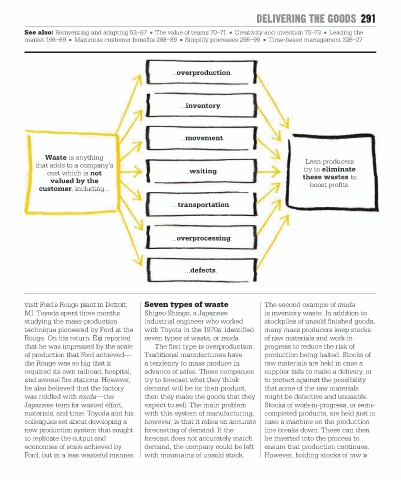
                                                ...overproduction.


                                                   ...inventory.


                                                   ...movement.


             Waste is anything                                                       Lean producers
           that adds to a company’s                                                  try to eliminate
              cost which is not                     ...waiting.
               valued by the                                                         these wastes to
                                                                                      boost profits.
            customer, including...
                                                 ...transportation.


                                                ...overprocessing.


                                                    ...defects.


        visit Ford’s Rouge plant in Detroit,   Seven types of waste       The second example of muda
        MI. Toyoda spent three months    Shigeo Shingo, a Japanese        is inventory waste. In addition to
        studying the mass-production     industrial engineer who worked   stockpiles of unsold finished goods,
        technique pioneered by Ford at the   with Toyota in the 1970s, identified   many mass producers keep stocks
        Rouge. On his return, Eiji reported   seven types of waste, or muda.   of raw materials and work-in-
        that he was impressed by the scale   The first type is overproduction.   progress to reduce the risk of
        of production that Ford achieved—  Traditional manufacturers have    production being halted. Stocks of
        the Rouge was so big that it     a tendency to mass produce in    raw materials are held in case a
        required its own railroad, hospital,   advance of sales. These companies   supplier fails to make a delivery, or
        and several fire stations. However,   try to forecast what they think   to protect against the possibility
        he also believed that the factory   demand will be for their product,   that some of the raw materials
        was riddled with muda—the        then they make the goods that they   might be defective and unusable.
        Japanese term for wasted effort,   expect to sell. The main problem   Stocks of work-in-progress, or semi-
        materials, and time. Toyoda and his   with this system of manufacturing,   completed products, are held just in
        colleagues set about developing a   however, is that it relies on accurate  case a machine on the production
        new production system that sought   forecasting of demand. If the   line breaks down. These can then
        to replicate the output and      forecast does not accurately match   be inserted into the process to
        economies of scale achieved by   demand, the company could be left   ensure that production continues.
        Ford, but in a less wasteful manner.  with mountains of unsold stock.   However, holding stocks of raw ❯❯

