


Page 297 - (DK) The Business Book
P. 297
DELIVERING THE GOODS        295

        See also: Luck (and how to get lucky) 42   ■  How fast to grow 44–45   ■  Avoiding complacency 194–201   ■  Promotions and
        incentives 271   ■  Why advertise? 272–73   ■  Forecasting 278–79   ■  Lean production 290–93   ■  Simplify processes 296–99


        final product or to replace defective   costs: warehouse space is
        materials. This strategy ensures that  expensive, and employees are
        production can continue in the   needed to manage it. It can also
        event of a delay from the supplier;   lose value if it perishes or becomes
        companies are more likely to hold   technologically obsolete. There is
        stocks of raw materials if their   also an opportunity cost associated   Because of our inventory
        supplier is unreliable. They may also   with holding stock; the cash tied   management, Dell is able to
        keep stocks of “work-in-progress,” or   up in stock could be earning   offer some of the newest
        semicompleted products. Work-in-  interest, or be invested elsewhere.   technologies at low prices
        progress stock can keep production   The goal is to hold just enough   while our competitors struggle
        flowing even if a machine on the   stock to meet demand, with         to sell off older products.
        assembly line breaks down.       minimum delay to the customer and          Paul Bell
                                         at minimum cost to the company. A   US former senior executive, Dell, Inc.
        Stock control                    sophisticated computer program at
        Good stock management balances   McDonalds, called Manugistics,
        meeting product demand with      helps the chain forecast sales and
        minimizing stock-holding costs. If a   ensure the correct quantity of stock
        company runs out of stock, it may   is ordered for the week ahead.
        have to turn orders away, or deliver
        late and risk losing returning   Buffer stock                     amount of buffer stock needed. If
        customers. In 1993 toy manufacturer  Most companies hold buffer   demand is stable and predictable,
        Bandai was caught off guard by the   stock—stock that exceeds the   the need for large quantities of
        popularity of its Power Rangers   amount needed to meet current   buffer stock is reduced.
        figures, and had to impose a “one   demand. It takes time to replenish   Online companies may not
        figure per customer” rule in the UK   stocks, so companies will reorder   need a storefront. However, unless
        until manufacturing could catch up   from suppliers well before their   their product can be digitally
        with the huge demand.            inventory falls below the buffer   downloaded, many will still require
           On the other hand, if a company   level. The longer the lead time—the   a physical storage facility, with the
        is overly cautious and holds too   time between placing an order and   same need to manage inventory
        much stock, it incurs unnecessary   the goods arriving—the greater the   and keep buffer stock.  ■

                                         Hornby                           lengthened its lead times: it
                                                                          takes six weeks to transport
                                         To help recover the nearly       freight by sea from China to the
                                         $14 (£9) billion cost of staging the   UK. Hornby has to supply
                                         London 2012 Olympics, the UK     customers from stock, rather
                                         sold rights to produce Olympics   than current production, so sales
                                         merchandise. Hornby paid for the   of Olympic products had to be
                                         right to produce official 2012 toys,   predicted well in advance.
                                         including Corgi models of London    Forecasts proved to be
                                         taxis and buses, its model trains   extremely optimistic. Hornby
                                         marked with the Olympics logo,   hoped to make a profit of $3.2
                                         and the Olympic mascots Wenlock   (£2) million from the Olympics. In
                                         and Mandeville.                  the end, the contract cost it $2
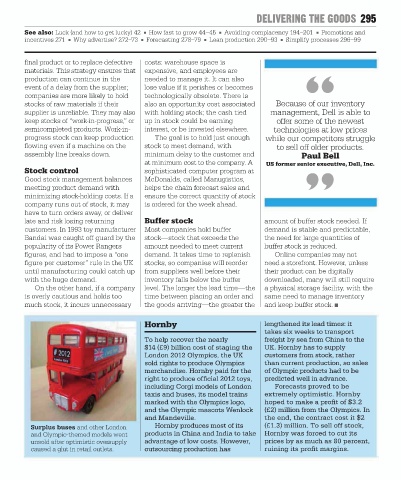
          Surplus buses and other London    Hornby produces most of its   (£1.3) million. To sell off stock,
          and Olympic-themed models went   products in China and India to take  Hornby was forced to cut its
          unsold after optimistic oversupply   advantage of low costs. However,   prices by as much as 80 percent,
          caused a glut in retail outlets.  outsourcing production has    ruining its profit margins.

