


Page 294 - (DK) The Business Book
P. 294
292 LEAN PRODUCTION


                                         looking for tools, walking from one   The final muda is the production
                                         part of the factory to another, or   of defective items. Substandard
                                         bending to pick up parts. This type   products signify waste of time and
                                         of waste increases cycle time—the   resources, and mean that further
                                         time taken to produce a unit of   inspection processes are required
                                         output. Longer cycle times lead to   and the products must be reworked.
                                         lower productivity, which in turn   In addition to the seven types of
                                         drives up unit labor costs.      muda, Toyota identifies two other
                                            The fourth muda is time spent   potential problems: mura and muri.
                                         waiting. Delays may occur when   Mura is uneven flow in a process,
                                         machines on a production line are   leading to unbalanced working
                                         poorly coordinated, resulting in   practices. Muri is the overburdening
                                         bottlenecks. Time might also be   of people or equipment.
                                         wasted resetting machinery to
        Holding goods in stock is a cost for    produce a different part.   Lean strategy
        a company, since warehouse space
        and employees need to be paid for. In   The fifth muda is transportation.   Using these insights, production
        addition, cash tied up in stock could be   Time and money spent moving   engineer Taiichi Ohno developed
        in the bank instead, earning interest.   work-in-progress from one factory   the Toyota Production System
                                         to another will drive up costs, and   (TPS). This lean production method
        materials and work-in-progress is   this is unlikely to add value to the   counters waste in the production
        considered wasteful because of the   product, so it is wasteful.   process by producing more using
        associated space and staff costs.   The sixth example of muda is   less. It enables a manufacturer to
           The third type of muda that   overprocessing. Consumers will   increase output without having to
        Shingo identified is movement. In   only pay for the product features   pay for extra labor, raw materials, or
        some factories, workstations are   that they value. Producing complex,  capital. Alternatively, a business
        badly designed, and employees    overengineered products is wasteful   can use lean production techniques
        spend time doing things that do not  because it creates additional costs   to make a better-quality product
        add value to the product, such as   without any extra revenue.    that will sell for a higher price.

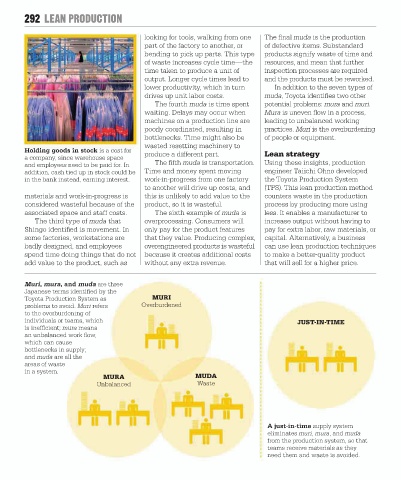
        Muri, mura, and muda are three
        Japanese terms identified by the
        Toyota Production System as        MURI
        problems to avoid. Muri refers   Overburdened
        to the overburdening of
        individuals or teams, which                                                JUST-IN-TIME
        is inefficient; mura means
        an unbalanced work flow,
        which can cause
        bottlenecks in supply;
        and muda are all the
        areas of waste
        in a system.
                              MURA                     MUDA
                            Unbalanced                 Waste


                                                                           A just-in-time supply system
                                                                           eliminates muri, mura, and muda
                                                                           from the production system, so that
                                                                           teams receive materials as they
                                                                           need them and waste is avoided.

