


Page 299 - (DK) The Business Book
P. 299
DELIVERING THE GOODS        297

        See also: Stand out in the market 28–29   ■  Creativity and invention 72–73   ■  Thinking outside the box 88–89   ■  The
        learning organization 202–07   ■  The value chain 216–217   ■  Lean production 290–93   ■  Kaizen 302–09


                                                            Costs can be reduced by
                  In competitive markets,
                  consumers look for value                  streamlining processes
                       for money.                           or simplifying products.


                           To reduce the price of their                          Eliminate
                        products, companies may choose to                  unnecessary steps.
                         lower their production costs.


        of a process that was successfully   iron to create steel were removed   Watson Hendry invented plastic-
        simplified is steel manufacturing.   from the metal by blowing air   injection-molding technology, which
        During the Industrial Revolution,   through the iron during the   was used to produce one-piece
        huge quantities of steel were needed  production process. Bessemer’s   chairs and tables much more
        to build bridges, ships, and railroads.  simpler production method was more  cheaply than wood.
        Steel was in short supply because it  fuel efficient. As a result, the cost of
        was expensive to produce. In     making steel fell from as much as   Mass production
        Britain, steel had been made in   $97 (£60) per ton to $11 (£7) per ton.   In the early 1900s, Henry Ford
        high-temperature, coke-fired         In some cases, simplifying a   revolutionized manufacturing
        furnaces since the 1740s. Small   process can mean using different   by standardizing the method
        quantities of iron were loaded into   materials. In 1946 in the US, James   used to make cars. Before Ford’s ❯❯
        small clay crucibles (containers that
        withstood heat) and placed inside
        the furnace. After three hours,
        impurities were scraped from the
        crucibles, leaving the steel behind.
        Simplifying the process
        In the 1850s the production method
        was simplified by the British
        engineer Henry Bessemer. His
        so-called Bessemer process did not
        require crucibles. Instead, the
        impurities generated from heating


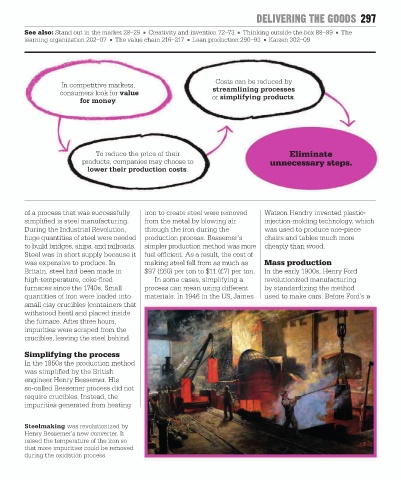
        Steelmaking was revolutionized by
        Henry Bessemer’s new converter. It
        raised the temperature of the iron so
        that more impurities could be removed
        during the oxidation process.

