


Page 79 - (DK) The Business Book
P. 79
LIGHTING THE FIRE        77

        See also: Leading well 68–69   ■  Effective leadership 78–79   ■  Organizational   Charles Handy
        culture 104–09   ■  Mintzberg’s management roles 112–13
                                                                            Professor Charles Handy, born
                                                                            in 1932, is Britain’s best-
                                                                            known management guru.
                                                                            After graduating from Oxford
                                                                            University he joined the
                                                                            Massachusetts Institute of
                                                                            Technology in 1965, moving
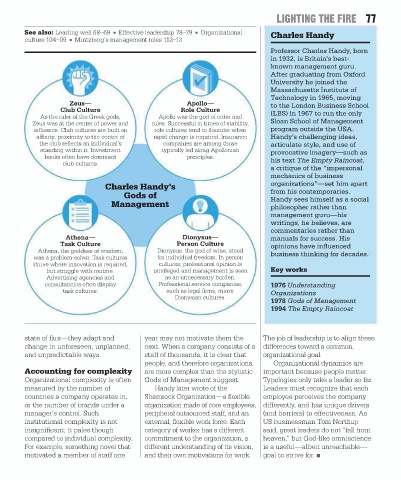
                    Zeus—                            Apollo—                to the London Business School
                  Club Culture                     Role Culture
            As the ruler of the Greek gods,    Apollo was the god of order and    (LBS) in 1967 to run the only
          Zeus was at the center of power and   rules. Successful in times of stability,   Sloan School of Management
          influence. Club cultures are built on   role cultures tend to flounder when   program outside the USA.
           affinity; proximity to the center of    rapid change is required. Insurance   Handy’s challenging ideas,
            the club reflects an individual’s   companies are among those    articulate style, and use of
            standing within it. Investment    typically led along Apollonian   provocative imagery—such as
             banks often have dominant              principles.             his text The Empty Raincoat,
                  club cultures.
                                                                            a critique of the “impersonal
                                                                            mechanics of business
                              Charles Handy’s                               organizations”—set him apart
                                                                            from his contemporaries.
                                   Gods of                                  Handy sees himself as a social
                                Management                                  philosopher rather than
                                                                            management guru—his
                                                                            writings, he believes, are
                                                                            commentaries rather than
                   Athena—                         Dionysus—                manuals for success. His
                  Task Culture                    Person Culture            opinions have influenced
           Athena, the goddess of wisdom,    Dionysus, the god of wine, stood
          was a problem-solver. Task cultures   for individual freedom. In person   business thinking for decades.
          thrive where innovation is required,   cultures, professional opinion is
              but struggle with routine.   privileged and management is seen   Key works
              Advertising agencies and         as an unnecessary burden.
             consultancies often display     Professional service companies,    1976 Understanding
                  task cultures.               such as legal firms, mirror    Organizations
                                                 Dionysian cultures.
                                                                            1978 Gods of Management
                                                                            1994 The Empty Raincoat


        state of flux—they adapt and      year may not motivate them the   The job of leadership is to align these
        change in unforeseen, unplanned,   next. When a company consists of a  differences toward a common,
        and unpredictable ways.          staff of thousands, it is clear that   organizational goal.
                                         people, and therefore organizations,   Organizational dynamics are
        Accounting for complexity        are more complex than the stylistic   important because people matter.
        Organizational complexity is often   Gods of Management suggest.  Typologies only take a leader so far.
        measured by the number of           Handy later wrote of the      Leaders must recognize that each
        countries a company operates in,    Shamrock Organization—a flexible   employee perceives the company
        or the number of brands under a   organization made of core employees,  differently, and has unique drivers
        manager’s control. Such          peripheral outsourced staff, and an   (and barriers) to effectiveness. As
        institutional complexity is not   external, flexible work force. Each   US businessman Tom Northup
        insignificant; it pales though    category of worker has a different   said, great leaders do not “fall from
        compared to individual complexity.   commitment to the organization, a   heaven,” but God-like omniscience
        For example, something novel that   different understanding of its vision,   is a useful—albeit unreachable—
        motivated a member of staff one   and their own motivations for work.   goal to strive for. ■

