


Page 93 - (DK) The Business Book
P. 93
LIGHTING THE FIRE        91 91

        See also: Leading well 68–69   ■  The value of teams 70–71   ■  Creativity and   Frederick Herzberg
        invention 72–73   ■  Effective leadership 78–79   ■  Make the most of your talent 86–87
                                                                            US psychologist Frederick
                                                                            Herzberg was born on April
               JOB DISSATISFACTION               JOB SATISFACTION           18, 1923. He attended City
                                                                            College of New York and later
                                                                            held a professorship at the
                                                              Achievement
                                                                            University of Utah, USA.
                                                         Recognition        Herzberg’s service in the
                                                                            US Army, in particular his
                                                    Work itself
                                                                            observation of conditions
                                                    Responsibility          at the Dachau concentration
                                              Advancement                   camp in Germany during
                                                                            World War II, is thought to
                                            Growth
                                                                            have inspired his interest
        Company policy and                                                  in motivational theory.
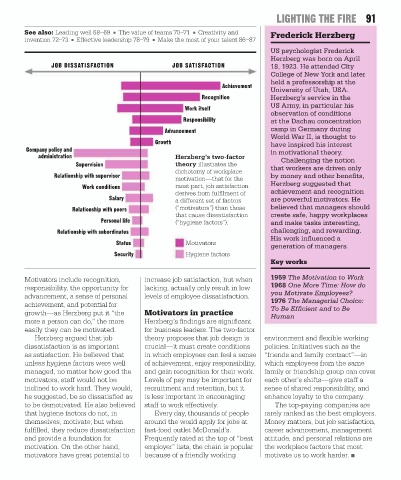
            administration                       Herzberg’s two-factor        Challenging the notion
                      Supervision                theory illustrates the     that workers are driven only
                                                 dichotomy of workplace
                Relationship with supervisor                                by money and other benefits,
                                                 motivation—that for the
                        Work conditions          most part, job satisfaction   Herzberg suggested that
                                                 derives from fulfilment of    achievement and recognition
                               Salary            a different set of factors   are powerful motivators. He
                     Relationship with peers     (“motivators”) than those   believed that managers should
                                                 that cause dissatisfaction   create safe, happy workplaces
                             Personal life       (“hygiene factors”).       and make tasks interesting,
                 Relationship with subordinates                             challenging, and rewarding.
                                                                            His work influenced a
                                 Status             Motivators
                                                                            generation of managers.
                                 Security           Hygiene factors
                                                                            Key works

        Motivators include recognition,   increase job satisfaction, but when   1959 The Motivation to Work
                                                                            1968 One More Time: How do
        responsibility, the opportunity for   lacking, actually only result in low
                                                                            you Motivate Employees?
        advancement, a sense of personal   levels of employee dissatisfaction.
                                                                            1976 The Managerial Choice:
        achievement, and potential for                                      To Be Efficient and to Be
        growth—as Herzberg put it “the   Motivators in practice
                                                                            Human
        more a person can do,” the more   Herzberg’s findings are significant
        easily they can be motivated.    for business leaders. The two-factor
           Herzberg argued that job      theory proposes that job design is   environment and flexible working
        dissatisfaction is as important    crucial—it must create conditions   policies. Initiatives such as the
        as satisfaction. He believed that   in which employees can feel a sense  “friends and family contract”—in
        unless hygiene factors were well   of achievement, enjoy responsibility,  which employees from the same
        managed, no matter how good the   and gain recognition for their work.   family or friendship group can cover
        motivators, staff would not be   Levels of pay may be important for   each other’s shifts—give staff a
        inclined to work hard. They would,   recruitment and retention, but it    sense of shared responsibility, and
        he suggested, be so dissatisfied as   is less important in encouraging   enhance loyalty to the company.
        to be demotivated. He also believed  staff to work effectively.      The top-paying companies are
        that hygiene factors do not, in     Every day, thousands of people   rarely ranked as the best employers.
        themselves, motivate; but when   around the world apply for jobs at   Money matters, but job satisfaction,
        fulfilled, they reduce dissatisfaction   fast-food outlet McDonald’s.   career advancement, management
        and provide a foundation for     Frequently rated at the top of “best   attitude, and personal relations are
        motivation. On the other hand,   employer” lists, the chain is popular   the workplace factors that most
        motivators have great potential to   because of a friendly working   motivate us to work harder. ■

