


Page 28 - (DK Eyewitness) Travel Guide - Estonia Latvia & Lithuania
P. 28
26       INTRODUCING  EST ONIA ,  LA T VIA  AND  LITHU ANIA


        Famous People
        A history of cultural domination by other nations explains why
        only a handful of figures from the Baltic States are internationally
        known. It was only with the 19th-century national awakening
        movements that the notion of distinctive Baltic cultures gained
        popularity. After the brief confidence of the first independence,
        the restrictions of the Soviet era meant that most famous
        people from the region were either of Russian heritage or
        were living outside their native countries. In the years since
        independence in 1991, the arts have been hampered by
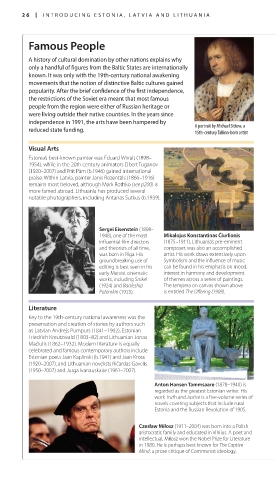
                                                   A portrait by Michael Sittow, a
        reduced state funding.
                                                   15th-century Tallinn-born artist
        Visual Arts
        Estonia’s best-known painter was Eduard Wiiralt (1898–
        1954), while in the 20th century animators Elbert Tuganov
        (1920–2007) and Priit Pärn (b.1946) gained international
        praise. Within Latvia, painter Janis Rozentāls (1866–1916)
        remains most beloved, although Mark Rothko (see p200) is
        more famed abroad. Lithuania has produced several
        notable photographers, including Antanas Sutkus (b.1939).


                           Sergei Eisenstein (1898–
                           1948), one of the most   Mikalojus Konstantinas Čiurlionis
                           influential film directors   (1875–1911), Lithuania’s pre-eminent
                           and theorists of all time,   composer, was also an accomplished
                           was born in Rīga. His   artist. His work draws extensively upon
                           groundbreaking use of   Symbolism and the influence of music
                           editing is best seen in his   can be found in his emphasis on mood,
                           early Marxist cinematic   interest in harmony and development
                           works, including Strike!   of themes across a series of paintings.
                           (1924) and Battleship   The tempera on canvas shown above
                           Potemkin (1925).  is entitled The Offering (1909).

        Literature
        Key to the 19th-century national awareness was the
        preservation and creation of stories by authors such
        as Latvian Andrejs Pumpurs (1841–1902), Estonian
        Friedrich Kreutzwald (1803–82) and Lithuanian Jonas
        Mačiulis (1862–1932). Modern literature is equally
        celebrated and famous con temporary authors include
        Estonian poets Jaan Kaplinski (b.1941) and Jaan Kross
        (1920–2007), and Lithuanian novelists Ričardas Gavelis
        (1950–2002) and Jurga Ivanauskaitė (1961–2007).
                                         Anton Hansen Tammsaare (1878–1940) is
                                         regarded as the greatest Estonian writer. His
                                         work Truth and Justice is a five-volume series of
                                         novels covering subjects that include rural
                                         Estonia and the Russian Revolution of 1905.

                                     Czesław Miłosz (1911–2004) was born into a Polish
                                     aristocratic family and educated in Vilnius. A poet and
                                     intellectual, Miłosz won the Nobel Prize for Literature
                                     in 1980. He is perhaps best known for The Captive
                                     Mind, a prose critique of Communist ideology.

