


Page 60 - All About History - Issue 08-14
P. 60
Hitler’s astronauts


        V-2 rocket with fins on the side that enabled it
        to strike targets over 800 kilometres (500 miles)  “ Hitler was infatuated with ‘miracle
        away after crossing the boundary into space,   weapons’, advanced tech threatening to
        later known as the Kármán line, 100 kilometres
        (62 miles) high. The A-9 and subsequent rocket   sway the war in Germany’s favour”
        designs would ultimately never leave the ground,
        but their potential was plain to see.  In 1940 and 1941, Hermann Oberth worked on   the rocket and have them manually fly it to its
          Building upon this work was the A-10, which   the design. Oberth and his fellow engineers   destination. An ejection seat would enable the
        can be regarded as one of the world’s first multi-  encountered a key problem, though. In attempting   pilot to escape shortly before the impact. In doing
        stage rockets. About 20 metres (65 feet) tall   to design a rocket that could travel over 5,000   so, with the rocket crossing the boundary into
        and weighing over 16,000 kilograms (35,000   kilometres (3,100 miles) to the US, they were   space, the team at Peenemünde were unwittingly
        pounds), this was a modified V-2 rocket with   unable to perfect a guiding system that would   designing the first spacecraft that would take the
        multiple engines, on top of which would be the   enable the rocket to accurately hit its target. The   world’s first astronaut into space.
        A-9 rocket. The two-stage rocket would separate   suggestion to use a string of radio beacons on both   The design, of course, was hugely ambitious. At
        once it reached space, leaving the A-9 to deliver its   sea and land was considered, but would require   the time nothing was known of human spaceflight
        payload to a target over 500 kilometres (310 miles)   men on the ground in the US to ‘paint’ targets   and it was not until 1951 that the Soviet Union
        away. After launching, the A-10 would descend   with such beacons.             sent animals into space. If such an endeavour were
        back to Earth via parachutes, allowing it to be   Instead they came up with a radical design, one   to be successful, it’s likely any early pilots would
        recovered and re-used for further launches.  that had not been seriously considered before.   almost certainly be throwing their lives away
          The ultimate goal of the A-9 and A-10 was to be   If they could modify the A-9 rocket to include a   before the technology was perfected. Analysis
        able to attack the US with launches from Europe.   pressurised cockpit, they could place a pilot in   of von Braun and his team’s plans after the war


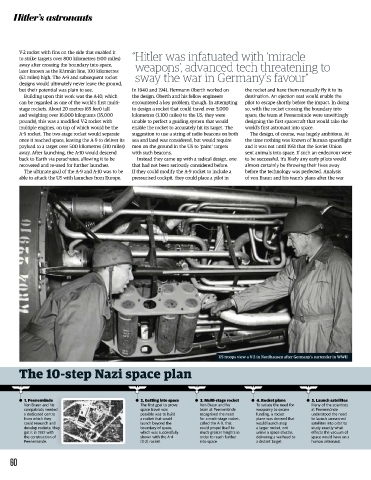
                                                                              US troops view a V-2 in Nordhausen after Germany’s surrender in WWII


        The 10-step Nazi space plan


        ●  1. Peenemünde                         ●  2. Getting into space  ●  3. Multi-stage rocket  ●  4. Rocket plane  ●  5. Launch satellites
         Von Braun and his                        The first goal to prove   Von Braun and his   To satiate the need for   Many of the scientists
         compatriots needed                       space travel was     team at Peenemünde   weaponry to secure   at Peenemünde
         a dedicated centre                       possible was to build   recognised the need   funding, a rocket   understood the need
         from which they                          a rocket that could   for a multi-stage rocket,   plane was devised that   to launch unmanned
         could research and                       launch beyond the    called the A-9, that   would launch atop   satellites into orbit to
         develop rockets; they                    boundary of space,   could propel itself to   a larger rocket, not   study exactly what
         got it in 1937 with                      which was successfully   much greater heights in   unlike a space shuttle,   effects the vacuum of
         the construction of                      shown with the A-4   order to reach further   delivering a warhead to   space would have on a
         Peenemünde.                              (V-2) rocket.        into space.         a distant target.  human astronaut.


     60

