


Page 152 - Nilam_Publication_module_Chemistry_Form.pdf
P. 152
MODULE • Chemistry Form 4


               Constructing Ionic Equation for the Formation of Insoluble Salt
               Membina Persamaan Ion bagi Pembentukan Garam Tak Larut


             1   The ionic equation for the formation of insoluble salt can be constructed if the number of moles of anion and cation to
                 form 1 mol of insoluble salt are known.
                 Persamaan kimia untuk pembentukan garam tak terlarut dapat ditulis jika bilangan mol anion dan kation untuk membentuk 1 mol garam tak
                 larut diketahui.
             2   The number mol of cation and anion which combined to form 1 mol of insoluble salt is determined experimentally by a
                 continuous method:
                 Bilangan mol kation dan anion yang bergabung untuk membentuk 1 mol garam tak terlarut dapat ditentukan secara eksperimen menggunakan
                 kaedah perubahan berterusan:
                 (a)  A fixed volume of a solution A contains cations, X  of the insoluble salt reacts with increasing volume of another
                                                               m+
                     solution B contains the anions, Y  of the insoluble salt.
                                                 n–
                     Isi padu tetap larutan A mengandungi kation, X  daripada garam tak terlarut bertindak balas dengan isi padu yang meningkat larutan
                                                       m+
                                           n–
                     B yang mengandungi anion, Y  daripada garam tak terlarut.
                 (b)  The volume of solution B needed to completely react with fixed volume of solution A is determined.
                     Isi padu larutan B yang diperlukan untuk bertindak balas dengan isi padu larutan A yang ditetapkan ditentukan.
                                                     n–
                                         m+
                 (c)  The number of mol of X  react with Y  is calculated based on the result of the experiment.
                                                         n–
                                m+
                     Bilangan mol X  yang bertindak balas dengan Y  dihitung berdasarkan keputusan eksperimen.
                 (d)  The simplest ration of mol of X : mol of Y  is calculated.
                                                         n–
                                               m+
                                             m+
                     Nisbah di antara bilangan mol X : bilangan mol Y  dihitung.
                                                           n–
                 (e)  Use the ratio to construct ionic equation.
                     Gunakan nisbah tersebut untuk membina persamaan ion.
             3   Example: / Contoh:
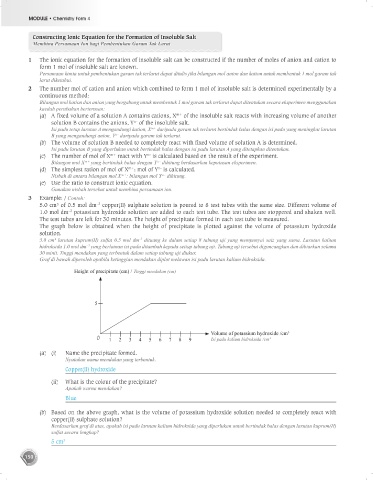
                 5.0 cm³ of 0.5 mol dm  copper(II) sulphate solution is poured to 8 test tubes with the same size. Different volume of
                                    –3
                 1.0 mol dm  potassium hydroxide solution are added to each test tube. The test tubes are stoppered and shaken well.
                           –3
                 The test tubes are left for 30 minutes. The height of precipitate formed in each test tube is measured.
                 The  graph  below  is  obtained  when  the  height  of  precipitate  is  plotted  against  the  volume  of  potassium  hydroxide
                 solution.
                 5.0 cm³ larutan kuprum(II) sulfat 0.5 mol dm  dituang ke dalam setiap 8 tabung uji yang mempunyai saiz yang sama. Larutan kalium
                                                   –3
                 hidroksida 1.0 mol dm  yang berlainan isi padu ditambah kepada setiap tabung uji. Tabung uji tersebut digoncangkan dan dibiarkan selama
                                 –3
                 30 minit. Tinggi mendakan yang terbentuk dalam setiap tabung uji diukur.
                 Graf di bawah diperoleh apabila ketinggian mendakan diplot melawan isi padu larutan kalium hidroksida.
                             Height of precipitate (cm) / Tinggi mendakan (cm)
                                    5


                                                                           Volume of potassium hydroxide /cm 3
                                    0   1   2  3   4  5  6   7  8   9      Isi padu kalium hidroksida /cm 3

                 (a)  (i)   Name the precipitate formed.
                          Nyatakan nama mendakan yang terbentuk.
                          Copper(II) hydroxide

                     (ii)  What is the colour of the precipitate?
                          Apakah warna mendakan?
                          Blue

                 (b)  Based on the above graph, what is the volume of potassium hydroxide solution needed to completely react with
                     copper(II) sulphate solution?
                     Berdasarkan graf di atas, apakah isi padu larutan kalium hidroksida yang diperlukan untuk bertindak balas dengan larutan kuprum(II)
                     sulfat secara lengkap?
                     5 cm 3


            150
           Nilam Publication Sdn. Bhd.

        07-Chem F4 (3p).indd   150                                                                                 12/9/2011   5:55:22 PM

