


Page 158 - Nilam_Publication_module_Chemistry_Form.pdf
P. 158
MODULE • Chemistry Form 4


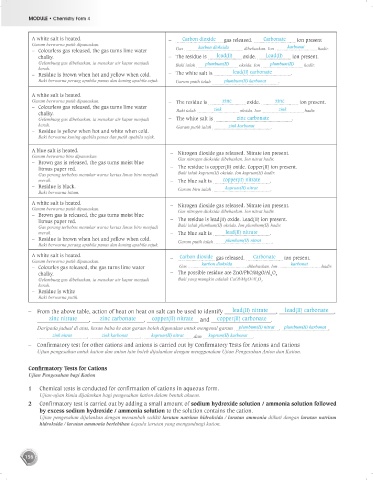
              A white salt is heated.                        –   Carbon dioxide    gas released.   Carbonate   ion present
              Garam berwarna putih dipanaskan.                                                       karbonat
              –  Colourless gas released, the gas turns lime water      Gas   karbon dioksida   dibebaskan. Ion    hadir.
                chalky.                                      –  The residue is   lead(II)   oxide.   Lead(II)   ion present.
                 Gelembung gas dibebaskan, ia menukar air kapur menjadi      Baki ialah   plumbum(II)   oksida. Ion   plumbum(II)   hadir.
                keruh.
              –  Residue is brown when hot and yellow when cold.  –  The white salt is   lead(II) carbonate  .
                 Baki berwarna perang apabila panas dan kuning apabila sejuk.     Garam putih ialah   plumbum(II) karbonat  .

              A white salt is heated.
              Garam berwarna putih dipanaskan.               –  The residue is   zinc   oxide.   zinc     ion present.
              –  Colourless gas released, the gas turns lime water          zink                  zink
                chalky.                                         Baki ialah            oksida. Ion           hadir.
                 Gelembung gas dibebaskan, ia menukar air kapur menjadi   –  The white salt is   zinc carbonate  .
                keruh.                                           Garam putih ialah   zink karbonat  .
              –  Residue is yellow when hot and white when cold.
                 Baki berwarna kuning apabila panas dan putih apabila sejuk.

              A blue salt is heated.                         –  Nitrogen dioxide gas released. Nitrate ion present.
              Garam berwarna biru dipanaskan.                   Gas nitrogen dioksida dibebaskan. Ion nitrat hadir.
              –  Brown gas is released, the gas turns moist blue
                litmus paper red.                            –  The residue is copper(II) oxide. Copper(II) ion present.
                 Gas perang terbebas menukar warna kertas limus biru menjadi      Baki ialah kuprum(II) oksida. Ion kuprum(II) hadir.
                merah.                                       –  The blue salt is   copper(II) nitrate  .
              –  Residue is black.                                              kuprum(II) nitrat
                 Baki berwarna hitam.                            Garam biru ialah              .
              A white salt is heated.                        –  Nitrogen dioxide gas released. Nitrate ion present.
              Garam berwarna putih dipanaskan.                  Gas nitrogen dioksida dibebaskan. Ion nitrat hadir.
              –  Brown gas is released, the gas turns moist blue
                litmus paper red.                            –  The residue is lead(II) oxide. Lead(II) ion present.
                 Gas perang terbebas menukar warna kertas limus biru menjadi      Baki ialah plumbum(II) oksida. Ion plumbum(II) hadir.
                merah.                                       –  The blue salt is   lead(II) nitrate  .
              –  Residue is brown when hot and yellow when cold.                plumbum(II) nitrat
                 Baki berwarna perang apabila panas dan kuning apabila sejuk.      Garam putih ialah   .
              A white salt is heated.                        –   Carbon dioxide  gas released.   Carbonate   ion present.
              Garam berwarna putih dipanaskan.                          karbon dioksida               karbonat
              –  Colourles gas released, the gas turns lime water      Gas              dibebaskan. Ion          hadir.
                chalky.                                      –  The possible residue are ZnO/PbO/MgO/Al O
                                                                                                 3
                                                                                               2
                 Gelembung gas dibebaskan, ia menukar air kapur menjadi       Baki yang mungkin adalah CaOl/MgO/Al O .
                                                                                            3
                                                                                           2
                keruh.
              –  Residue is white
                 Baki berwarna putih.
             –  From the above table, action of heat on heat on salt can be used to identify   lead(II) nitrate  ,   lead(II) carbonate  ,
                    zinc nitrate  ,   zinc carbonate  ,   copper(II) nitrate    and    copper(II) carbonate   .
                Daripada jadual di atas, kesan haba ke atas garam boleh digunakan untuk mengenal garam   plumbum(II) nitrat  ,   plumbum(II) karbonat  ,
                     zink nitrat  ,   zink karbonat  ,   kuprum(II) nitrat   dan   kuprum(II) karbonat  .
             –  Confirmatory test for other cations and anions is carried out by Confirmatory Tests for Anions and Cations
                Ujian pengesahan untuk kation dan anion lain boleh dijalankan dengan menggunakan Ujian Pengesahan Anion dan Kation.

             Conf rmatory Tests for Cations
             Ujian Pengesahan bagi Kation

             1   Chemical tests is conducted for confirmation of cations in aqueous form.
                 Ujian-ujian kimia dijalankan bagi pengesahan kation dalam bentuk akueus.
             2   Confirmatory test is carried out by adding a small amount of sodium hydroxide solution / ammonia solution followed
                 by excess sodium hydroxide / ammonia solution to the solution contains the cation.
                 Ujian pengesahan dijalankan dengan menambah sedikit larutan natrium hidroksida / larutan ammonia diikuti dengan larutan natrium
                 hidroksida / larutan ammonia berlebihan kepada larutan yang mengandungi kation.


            156
           Nilam Publication Sdn. Bhd.

        07-Chem F4 (3p).indd   156                                                                                 12/9/2011   5:55:23 PM

