


Page 15 - Human Environment Interface (4)
P. 15
Brain Reading for Human-Machine Interfaces

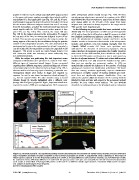
position in order to reach a virtual target ball which was presented      while unimportant stimuli should not (see Fig. 12D). All three
in the upper right corner marking a possible object which could be        virtual response objects were presented at a position in the HMD
manipulated in a final application case (Fig. 12A and B). A hand-         that followed the head movement to assure that all three objects
tracking system was used to detect the point in time when the hand        were always visible on the left side of the visual field. Again
left the armrest. Whenever subjects moved their arm 5 cm away             subjects were instructed to always respond to the target stimuli.
from the rest position, a marker for movement onset was sent and          This was the more important task.
stored together with the EEG (movement marker was set at time
point ‘‘0’’, see Fig. 12C). After entering the target ball (see              In the following we present results that were conducted in the
Fig. 12B–2), the subject returned to the rest position. To support        Armrest setup. The main goal was to confirm our general approach
the rest state of the arm, an armrest was designed as part of our         of BR and to show that it still works in a dual BR scenario in which
testbed. This armrest was integrated into the setup to imitate the        two classified conditions may influence each other. Further, we re-
strong support of the arm by the exoskeleton during the position          tested the substitution of training examples and hence, partly
control in the teleoperation scenario. The arm and hand of the            classifier transfer in this scenario that is similar to the teleoperation
participant had to stay in the rest position for at least 5 seconds. In   scenario and produces even less training examples than the
case the subject left the rest position too early, the target ball would  Labyrinth Oddball scenario did. Some extra questions were
disappear. This served to avoid too rapid changes between rest            addressed for the detection of movement preparation. During
and movement which was necessary to assure sufficiently long              online detection of movement preparation the classifier should to
non-movement periods.                                                     some extent be time shift invariant, hence should not only be able
                                                                          to detect the EEG pattern at the point in time it was trained on,
   While the subject was performing this task, important versus           but also at adjacent instances. To obtain such a time shift invariant
unimportant information were presented at a ratio of 1:20. Three          classifier, Blankertz et al. [75] trained the classifier on two rather
different types of important stimuli (target 1) were presented            than just one window per movement marker. In [54], we
requiring three different responses, namely touching one of three         systematically analyzed the influence of the number of training
virtual target objects in the virtual scenario as shown in Fig. 12B-1,    windows per movement on classification performance. We found
whereas each kind of warning required touching a particular one.          that two training windows significantly improve classification
Unimportant stimuli were similar in shape and required no                 performance. A higher number of training windows per move-
response. In case the user missed an important stimulus (target 1),       ment does not significantly improve classification. Here, we
i.e., did not respond within 10 s after stimulus onset, a second          address the question which combination of two training windows
stimulus (target 2), visually highlighted with a different color          (labeled by their end time with respect to the movement marker)
(orange instead of green), appeared. Again, important stimuli were        provides the best results across subjects. The two windows
expected to evoke a P300 and overlapping later ERP components             identified can subsequently serve for all subjects and an exhaustive

Figure 12. Armrest scenario. The experimental setting Armrest is illustrated and most relevant ERP activity evoked by brain processes involved in
target recognition and failure in target recognition as well as motor preparation are shown. A: Experimental setup is displayed. B: Three types of
virtual response cubes (B-1) and the virtual target ball (B-2) are shown. C: Averaged difference curve between electrodes C3 and C4 (number of trials
for movement events: 279) shows differences recorded over the primary motor cortex ipsi- and contralateral to the side of movement (movement
onset marker at dashed line). D: Averaged ERP patterns at electrode Pz on different stimulus types (number of standards: 2968, number of targets:
156, number of missed targets: 9) are depicted.
doi:10.1371/journal.pone.0081732.g012

PLOS ONE | www.plosone.org                                                13 December 2013 | Volume 8 | Issue 12 | e81732

