


Page 210 - เอกสารประกอบการอบรม คณิตศาสตร์
P. 210
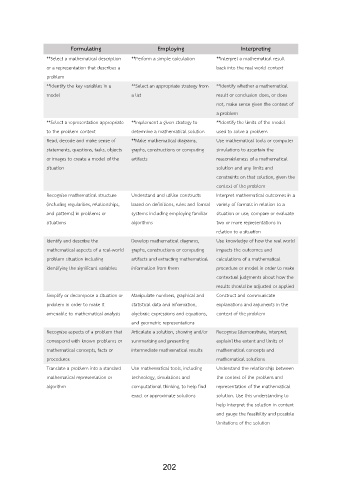
Formulating                   Employing                     Interpreting
                 **Select a mathematical description   **Perform a simple calculation    **Interpret a mathematical result
                 or a representation that describes a                        back into the real world context
                 problem
                 **Identify the key variables in a   **Select an appropriate strategy from   **Identify whether a mathematical
                 model                         a list                        result or conclusion does, or does
                                                                             not, make sense given the context of
                                                                             a problem
                 **Select a representation appropriate  **Implement a given strategy to   **Identify the limits of the model
                 to the problem context        determine a mathematical solution    used to solve a problem
                 Read, decode and make sense of   **Make mathematical diagrams,   Use mathematical tools or computer
                 statements, questions, tasks, objects   graphs, constructions or computing   simulations to ascertain the
                 or images to create a model of the   artifacts              reasonableness of a mathematical
                 situation                                                   solution and any limits and
                                                                             constraints on that solution, given the
                                                                             context of the problem
                 Recognise mathematical structure   Understand and utilise constructs   Interpret mathematical outcomes in a
                 (including regularities, relationships,   based on definitions, rules and formal  variety of formats in relation to a
                 and patterns) in problems or   systems including employing familiar   situation or use; compare or evaluate
                 situations                    algorithms                    two or more representations in
                                                                             relation to a situation
                 Identify and describe the     Develop mathematical diagrams,   Use knowledge of how the real world
                 mathematical aspects of a real-world  graphs, constructions or computing   impacts the outcomes and
                 problem situation including   artifacts and extracting mathematical   calculations of a mathematical
                 identifying the significant variables    information from them    procedure or model in order to make
                                                                             contextual judgments about how the
                                                                             results should be adjusted or applied
                 Simplify or decompose a situation or   Manipulate numbers, graphical and   Construct and communicate
                 problem in order to make it   statistical data and information,   explanations and arguments in the
                 amenable to mathematical analysis    algebraic expressions and equations,   context of the problem
                                               and geometric representations
                 Recognise aspects of a problem that   Articulate a solution, showing and/or   Recognise [demonstrate, interpret,
                 correspond with known problems or   summarising and presenting   explain] the extent and limits of
                 mathematical concepts, facts or   intermediate mathematical results    mathematical concepts and
                 procedures                                                  mathematical solutions
                 Translate a problem into a standard   Use mathematical tools, including   Understand the relationship between
                 mathematical representation or   technology, simulations and   the context of the problem and
                 algorithm                     computational thinking, to help find   representation of the mathematical
                                               exact or approximate solutions    solution. Use this understanding to
                                                                             help interpret the solution in context
                                                                             and gauge the feasibility and possible
                                                                             limitations of the solution


                                                          202

