


Page 136 - Applied Statistics with R
P. 136
136     CHAPTER 8. INFERENCE FOR SIMPLE LINEAR REGRESSION


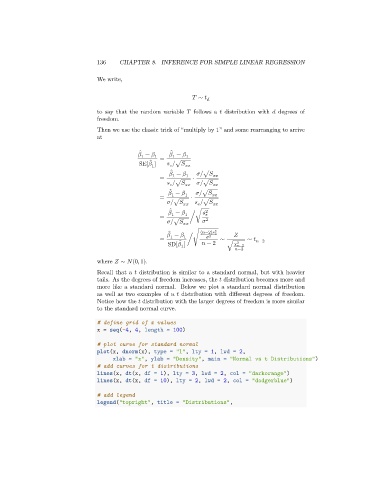
                                 We write,


                                                                    ∼
                                 to say that the random variable    follows a    distribution with    degrees of
                                 freedom.
                                 Then we use the classic trick of “multiply by 1” and some rearranging to arrive
                                 at

                                                ̂
                                                          ̂
                                                  −    1  =     −    1
                                                1
                                                          1
                                                   ̂
                                               SE[   ]     /√

                                                   1
                                                          ̂
                                                            −    1    /√
                                                          1
                                                      =          ⋅
                                                           /√           /√

                                                          ̂
                                                            −       /√
                                                      =   1   1  ⋅
                                                          /√            /√

                                                          ̂
                                                            −    1     2
                                                          1
                                                      =         / √
                                                          /√            2
                                                          ̂
                                                           −       (  −2)      2
                                                                      2
                                                      =  1    1  / √      ∼        ∼      −2
                                                             ̂
                                                         SD[   ]       − 2  √    2   −2
                                                             1
                                                                                 −2
                                 where    ∼   (0, 1).
                                 Recall that a    distribution is similar to a standard normal, but with heavier
                                 tails. As the degrees of freedom increases, the    distribution becomes more and
                                 more like a standard normal. Below we plot a standard normal distribution
                                 as well as two examples of a    distribution with different degrees of freedom.
                                 Notice how the    distribution with the larger degrees of freedom is more similar
                                 to the standard normal curve.
                                 # define grid of x values
                                 x = seq(-4, 4, length = 100)
                                 # plot curve for standard normal
                                 plot(x, dnorm(x), type = "l", lty = 1, lwd = 2,
                                      xlab = "x", ylab = "Density", main = "Normal vs t Distributions")
                                 # add curves for t distributions
                                 lines(x, dt(x, df = 1), lty = 3, lwd = 2, col = "darkorange")
                                 lines(x, dt(x, df = 10), lty = 2, lwd = 2, col = "dodgerblue")

                                 # add legend
                                 legend("topright", title = "Distributions",

