


Page 135 - Applied Statistics with R
P. 135
8.3. STANDARD ERRORS                                              135


                                                    ̂
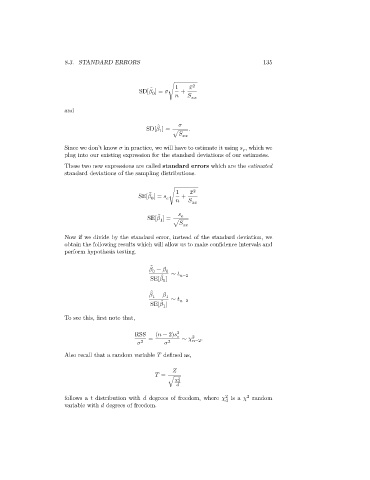
                                               SD[   ] =   √  1  +  2 ̄
                                                   0

                      and


                                                      ̂
                                                 SD[   ] =      .
                                                      1
                                                          √
                      Since we don’t know    in practice, we will have to estimate it using    , which we

                      plug into our existing expression for the standard deviations of our estimates.
                      These two new expressions are called standard errors which are the estimated
                      standard deviations of the sampling distributions.


                                                   ̂
                                               SE[   ] =    √ 1  +  2 ̄
                                                   0


                                                      ̂
                                                  SE[   ] =
                                                      1
                                                          √
                      Now if we divide by the standard error, instead of the standard deviation, we
                      obtain the following results which will allow us to make confidence intervals and
                      perform hypothesis testing.


                                                    ̂
                                                     −    0  ∼
                                                   0
                                                       ̂
                                                   SE[   ]    −2
                                                       0
                                                    ̂
                                                     −    1  ∼
                                                   1
                                                       ̂
                                                   SE[   ]    −2
                                                       1
                      To see this, first note that,
                                              RSS   (   − 2)   2     2
                                                 2  =     2  ∼      −2 .

                      Also recall that a random variable    defined as,


                                                       =
                                                         √    2

                                                                                   2
                                                                            2
                      follows a    distribution with    degrees of freedom, where    is a    random

                      variable with    degrees of freedom.

