


Page 150 - Applied Statistics with R
P. 150
150     CHAPTER 8. INFERENCE FOR SIMPLE LINEAR REGRESSION


                                 We can use the    statistic to perform this test.

                                                                          2


                                                               ∑   ( ̂ − ̄) /1

                                                          =         =1

                                                                        2
                                                            ∑   (   − ̂ ) /(   − 2)
                                                                =1
                                 In particular, we will reject the null when the    statistic is large, that is, when
                                 there is a low probability that the observations could have come from the null
                                 model by chance. We will let R calculate the p-value for us.
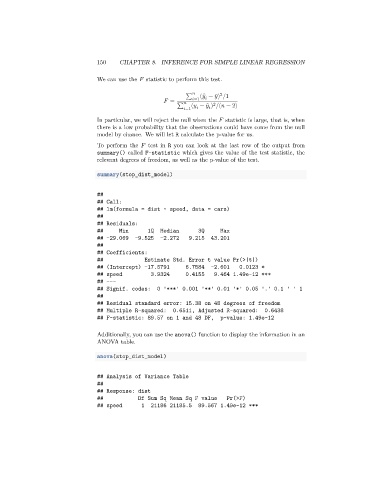
                                 To perform the    test in R you can look at the last row of the output from
                                 summary() called F-statistic which gives the value of the test statistic, the
                                 relevant degrees of freedom, as well as the p-value of the test.
                                 summary(stop_dist_model)


                                 ##
                                 ## Call:
                                 ## lm(formula = dist ~ speed, data = cars)
                                 ##
                                 ## Residuals:
                                 ##     Min       1Q  Median       3Q     Max
                                 ## -29.069   -9.525  -2.272   9.215   43.201
                                 ##
                                 ## Coefficients:
                                 ##              Estimate Std. Error t value Pr(>|t|)
                                 ## (Intercept) -17.5791      6.7584   -2.601   0.0123 *
                                 ## speed          3.9324     0.4155    9.464 1.49e-12 ***
                                 ## ---
                                 ## Signif. codes:   0 '***' 0.001 '**' 0.01 '*' 0.05 '.' 0.1 ' ' 1
                                 ##
                                 ## Residual standard error: 15.38 on 48 degrees of freedom
                                 ## Multiple R-squared:   0.6511, Adjusted R-squared:    0.6438
                                 ## F-statistic: 89.57 on 1 and 48 DF,    p-value: 1.49e-12

                                 Additionally, you can use the anova() function to display the information in an
                                 ANOVA table.

                                 anova(stop_dist_model)


                                 ## Analysis of Variance Table
                                 ##
                                 ## Response: dist
                                 ##            Df Sum Sq Mean Sq F value    Pr(>F)
                                 ## speed       1  21186 21185.5   89.567 1.49e-12 ***

