


Page 147 - Applied Statistics with R
P. 147
8.9. CONFIDENCE AND PREDICTION BANDS                              147


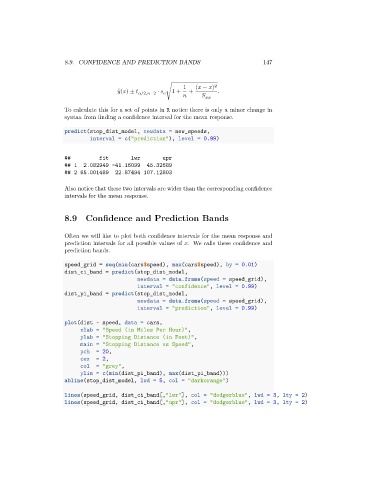
                                                              1   (   − ̄  ) 2
                                         ̂   (  ) ±      /2,  −2  ⋅    √1 +      +           .


                      To calculate this for a set of points in R notice there is only a minor change in
                      syntax from finding a confidence interval for the mean response.
                      predict(stop_dist_model, newdata = new_speeds,
                               interval = c("prediction"), level = 0.99)


                      ##          fit       lwr        upr
                      ## 1   2.082949 -41.16099   45.32689
                      ## 2 65.001489   22.87494 107.12803

                      Also notice that these two intervals are wider than the corresponding confidence
                      intervals for the mean response.


                      8.9 Confidence and Prediction Bands


                      Often we will like to plot both confidence intervals for the mean response and
                      prediction intervals for all possible values of   . We calls these confidence and
                      prediction bands.

                      speed_grid = seq(min(cars$speed), max(cars$speed), by = 0.01)
                      dist_ci_band = predict(stop_dist_model,
                                              newdata = data.frame(speed = speed_grid),
                                              interval = "confidence", level = 0.99)
                      dist_pi_band = predict(stop_dist_model,
                                              newdata = data.frame(speed = speed_grid),
                                              interval = "prediction", level = 0.99)

                      plot(dist ~ speed, data = cars,
                            xlab = "Speed (in Miles Per Hour)",
                            ylab = "Stopping Distance (in Feet)",
                            main = "Stopping Distance vs Speed",
                            pch  = 20,
                            cex  = 2,
                            col  = "grey",
                            ylim = c(min(dist_pi_band), max(dist_pi_band)))
                      abline(stop_dist_model, lwd = 5, col = "darkorange")

                      lines(speed_grid, dist_ci_band[,"lwr"], col = "dodgerblue", lwd = 3, lty = 2)
                      lines(speed_grid, dist_ci_band[,"upr"], col = "dodgerblue", lwd = 3, lty = 2)

