


Page 146 - Applied Statistics with R
P. 146
146     CHAPTER 8. INFERENCE FOR SIMPLE LINEAR REGRESSION


                                 To find confidence intervals for the mean response using R, we use the predict()
                                 function. We give the function our fitted model as well as new data, stored as
                                 a data frame. (This is important, so that R knows the name of the predictor
                                 variable.) Here, we are finding the confidence interval for the mean stopping
                                 distance when a car is travelling 5 miles per hour and when a car is travelling
                                 21 miles per hour.

                                 new_speeds = data.frame(speed = c(5, 21))
                                 predict(stop_dist_model, newdata = new_speeds,
                                          interval = c("confidence"), level = 0.99)


                                 ##          fit       lwr       upr
                                 ## 1  2.082949 -10.89309 15.05898
                                 ## 2 65.001489   56.45836 73.54462


                                 8.8 Prediction Interval for New Observations


                                 Sometimes we would like an interval estimate for a new observation,    , for a
                                 particular value of   . This is very similar to an interval for the mean response,
                                 E[   ∣    =   ], but different in one very important way.


                                 Our best guess for a new observation is still ̂(  ). The estimated mean is still
                                 the best prediction we can make. The difference is in the amount of variability.
                                 We know that observations will vary about the true regression line according
                                                                                                  2
                                           2
                                 to a   (0,    ) distribution. Because of this we add an extra factor of    to
                                 our estimate’s variability in order to account for the variability of observations
                                 about the regression line.


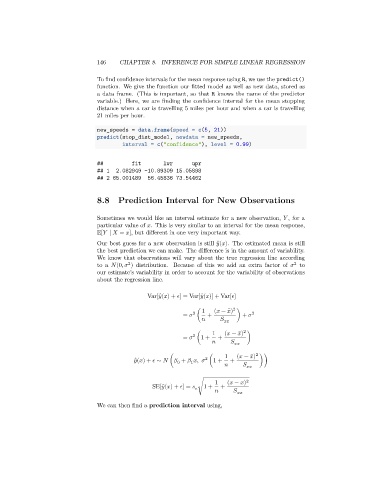
                                                  Var[ ̂(  ) +   ] = Var[ ̂(  )] + Var[  ]
                                                                    1   (   − ̄  ) 2
                                                                 2
                                                              =    (  +        ) +    2

                                                                       1   (   − ̄  ) 2
                                                                 2
                                                              =    (1 +  +         )

                                                                           1   (   − ̄  ) 2
                                                                     2
                                              ̂   (  ) +    ∼    (   +      ,    (1 +      +           ))
                                                                1
                                                            0
                                                                        1   (   − ̄  ) 2
                                                   SE[ ̂(  ) +   ] =    √1 +  +


                                 We can then find a prediction interval using,

