


Page 154 - Applied Statistics with R
P. 154
154                   CHAPTER 9. MULTIPLE LINEAR REGRESSION


                                 # read the data from the web
                                 autompg = read.table(
                                   "http://archive.ics.uci.edu/ml/machine-learning-databases/auto-mpg/auto-mpg.data",
                                   quote = "\"",
                                   comment.char = "",
                                   stringsAsFactors = FALSE)
                                 # give the dataframe headers
                                 colnames(autompg) = c("mpg", "cyl", "disp", "hp", "wt", "acc", "year", "origin", "name")
                                 # remove missing data, which is stored as "?"
                                 autompg = subset(autompg, autompg$hp != "?")
                                 # remove the plymouth reliant, as it causes some issues
                                 autompg = subset(autompg, autompg$name != "plymouth reliant")
                                 # give the dataset row names, based on the engine, year and name
                                 rownames(autompg) = paste(autompg$cyl, "cylinder", autompg$year, autompg$name)
                                 # remove the variable for name, as well as origin
                                 autompg = subset(autompg, select = c("mpg", "cyl", "disp", "hp", "wt", "acc", "year"))
                                 # change horsepower from character to numeric
                                 autompg$hp = as.numeric(autompg$hp)
                                 # check final structure of data
                                 str(autompg)


                                 ## 'data.frame':     390 obs. of   7 variables:
                                 ##  $ mpg : num   18 15 18 16 17 15 14 14 14 15 ...
                                 ##  $ cyl : int   8 8 8 8 8 8 8 8 8 8 ...
                                 ##  $ disp: num   307 350 318 304 302 429 454 440 455 390 ...
                                 ##  $ hp   : num  130 165 150 150 140 198 220 215 225 190 ...
                                 ##  $ wt   : num  3504 3693 3436 3433 3449 ...
                                 ##  $ acc : num   12 11.5 11 12 10.5 10 9 8.5 10 8.5 ...
                                 ##  $ year: int   70 70 70 70 70 70 70 70 70 70 ...


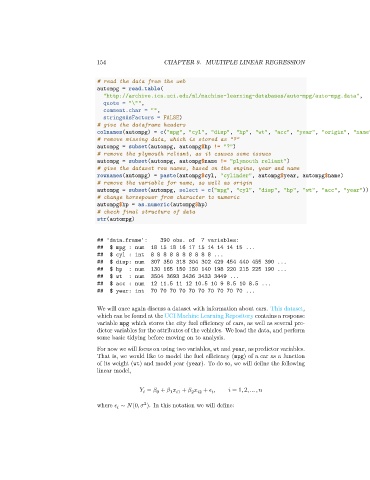
                                 We will once again discuss a dataset with information about cars. This dataset,
                                 which can be found at the UCI Machine Learning Repository contains a response
                                 variable mpg which stores the city fuel efficiency of cars, as well as several pre-
                                 dictor variables for the attributes of the vehicles. We load the data, and perform
                                 some basic tidying before moving on to analysis.
                                 For now we will focus on using two variables, wt and year, as predictor variables.
                                 That is, we would like to model the fuel efficiency (mpg) of a car as a function
                                 of its weight (wt) and model year (year). To do so, we will define the following
                                 linear model,


                                                  =    +       +       +    ,     = 1, 2, … ,
                                                         1   1
                                                     0


                                                                2   2
                                                 2
                                 where    ∼   (0,    ). In this notation we will define:


